
If AI Chatbots Get Google's Search Data, Does Ranking Matter Again?
By late July, the European Commission has to make a decision that almost nobody in the AEO conversation is watching.
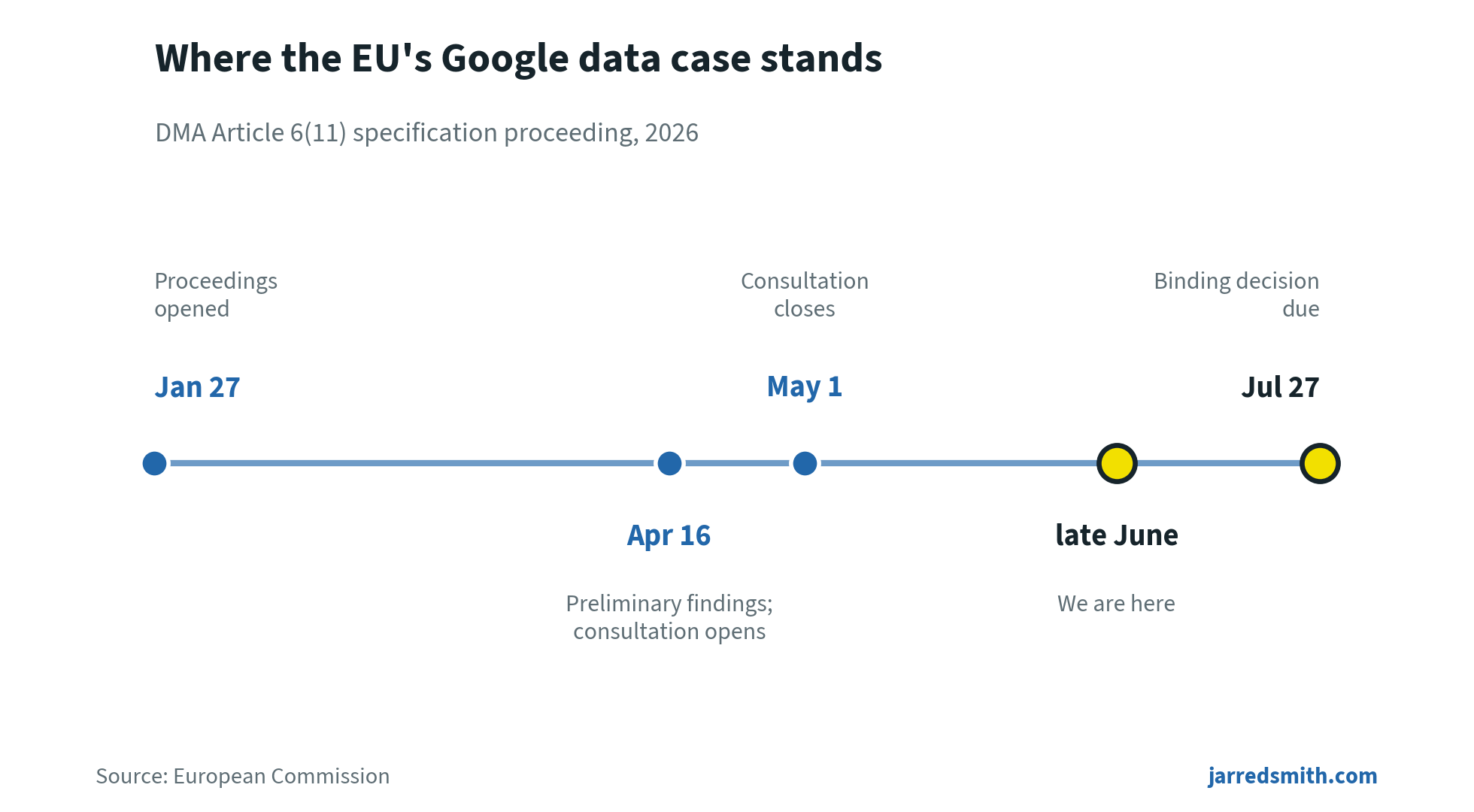
On April 16, the Commission sent Google a set of preliminary findings under the Digital Markets Act, spelling out how the company would have to share its search data with competitors. The consultation period closed May 1, and a binding decision is due by July 27 (Search Engine Journal). On its face this is an antitrust story. It’s something most of us would probably skip reading as it more pertains to the policy desk. If you read the eligibility section, though, it turns into something that touches how brands get found in AI search.
The list of companies that would get access to Google's data doesn't stop at Bing and DuckDuckGo. It includes AI chatbots that qualify as search engines under the DMA, and the coverage has named OpenAI and Anthropic as the types of products the Commission has in mind (Head Post). My question is if ChatGPT and Claude can learn from the same ranking and click signals Google uses, does the thing I keep telling people is fading, your Google ranking, come back to life inside AI answers?
Let me lay out what's on the table first.
What the Commission is asking for
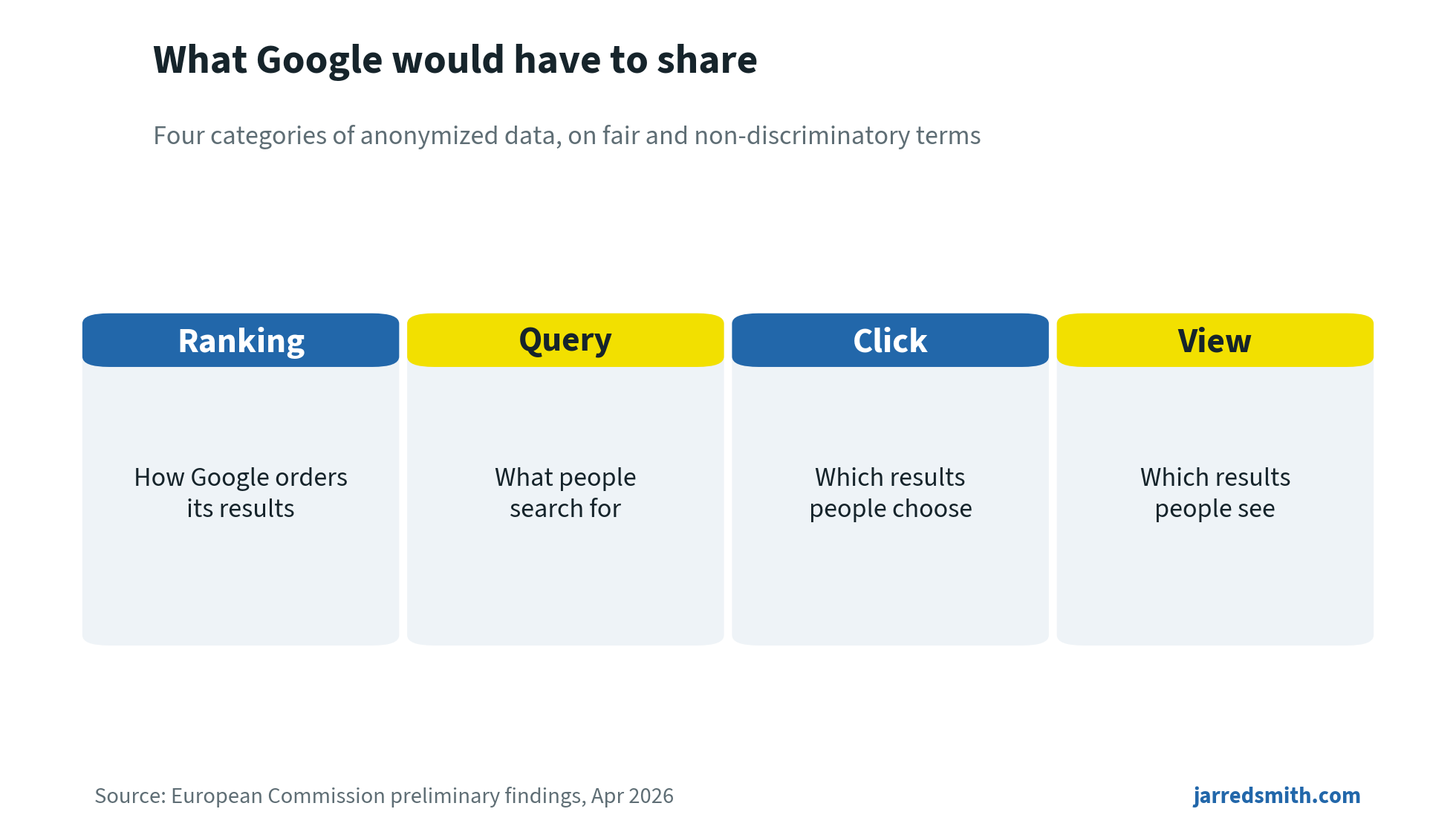
The proposal sits under Article 6(11) of the DMA, and it would require Google to hand four categories of anonymized data to approved "data beneficiaries" on fair, reasonable, and non-discriminatory terms - ranking data, query data, click data, and view data (Search Engine Journal). In regular terms, that's how Google orders its results, what people search for, which results they click, and which ones they see.
There's no access to Google's index, and no handing of your individual page's data to a competitor. The Commission is careful to say the data would be anonymized and aggregated, similar to what Alphabet already uses to tune its own search (Glitchwire). The findings also cover the machinery that makes or breaks a remedy like who qualifies, how often the data flows, how it gets anonymized, and what a fair price looks like.
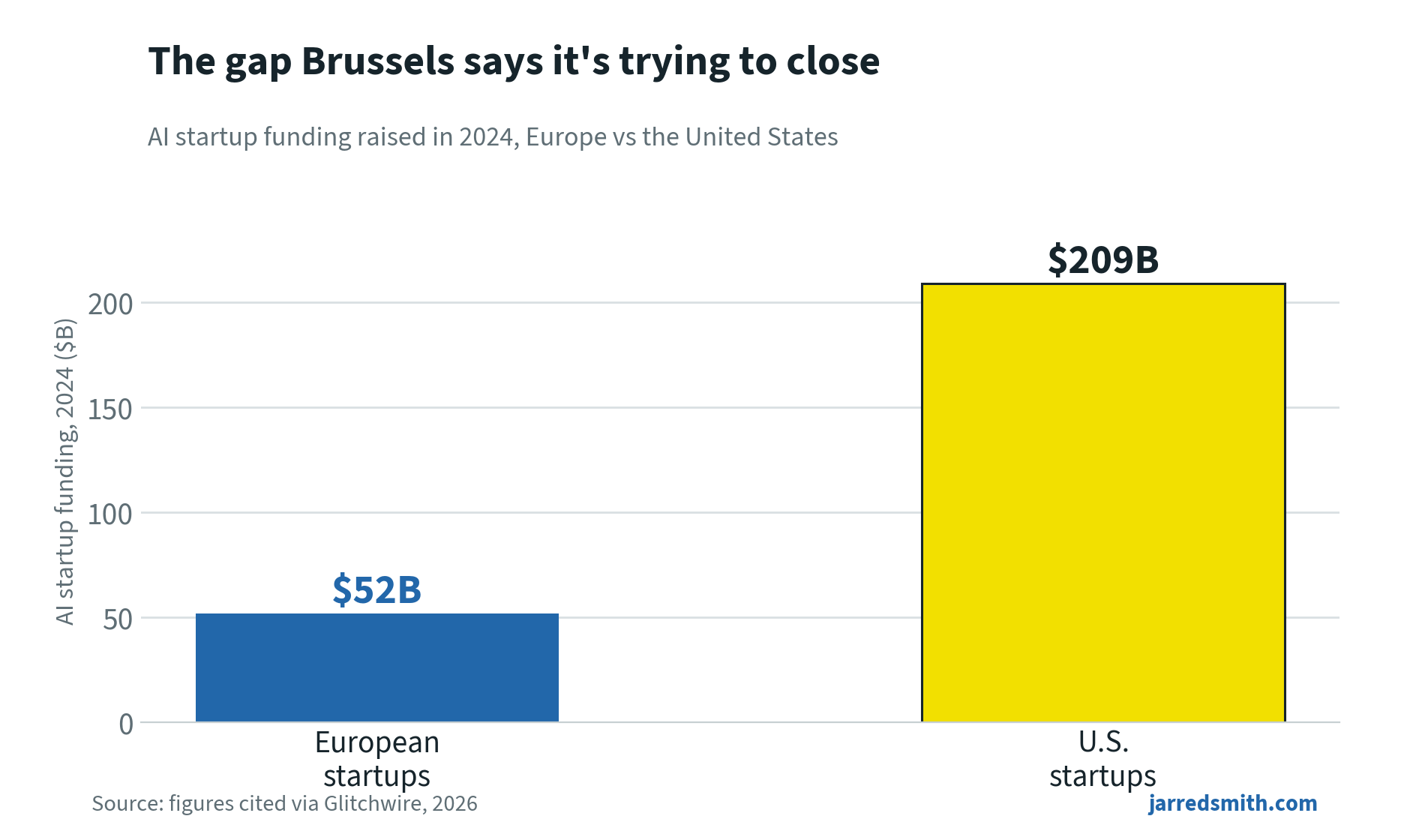
The reason Brussels is pushing is competition. The Commission's view is that Google's exclusive hold on this data is a structural barrier that keeps rivals from ever getting good enough to matter, and it points at the gap in AI investment to make the case. European AI startups raised about 52 billion dollars in 2024 against 209 billion in the US (Glitchwire). The argument is that no amount of venture money closes that gap while the incumbents sit on the inputs.
This has teeth, in case you assume Brussels makes noise and Google ignores it. The same DMA has already pushed Apple to allow third-party app stores and made Meta offer an ad-free version of its networks. Google has been fined roughly 9.71 billion euros across Europe since 2017, and DMA penalties can reach 10 percent of global revenue (Head Post). If the Commission adopts this in July, Google complies or pays.
What it could do to AI citations
For about two years the consensus in this space, mine included, has been that ranking in Google and getting cited by an AI engine are drifting apart. I've written about the data behind that drift. AI engines build their own picture of the web by crawling it and deciding for themselves what counts as authoritative, and the picture it built overlaps with Google's top ten far less than you'd expect.
The EU proposal pokes at the mechanism underneath the drift. If an eligible AI search product operating in Europe can see how Google ranks results and which ones people click, it gains a strong new signal for what the web treats as authoritative on a topic. It doesn't have to copy Google's order, and it won't. A model deciding whether to cite your page would now have access to Google's accumulated read on whether your page is any good, which is the most valuable dataset in search for twenty years.
Could your Google rank start feeding AI answers again?
I really don’t have a clear answer on this one.
I can argue it two ways. A strong Google ranking in Europe would stop being a Google-only asset; eligible AI engines could read the same signals, so the SEO work that earns you a good position might also feed an AI's sense that you're worth citing. That would pull two disciplines I've been treating as separate back toward each other, at least for European queries.
The other direction is at least as plausible. The data is anonymized and aggregated, so no AI gets a tidy list that says "cite this page." Instead, it gets a better model of relevance in general, which helps it build its own rankings rather than borrow Google's. An engine could use Google's click data to get sharper and still land on a citation list that looks nothing like Google's top ten. In that version your rank matters about as much as it does today, and the AI has just gotten better at its own job. I lean slightly toward the first reading for high-commercial queries, where Google's signal is richest, though I'd call that a hunch and hold it loosely.
What we don't know yet
Quite a lot, and I'd rather say so than sell certainty. The biggest unknown is whether AI-chatbot eligibility survives at all. Google is fighting it hard, with its competition counsel calling the privacy safeguards "dangerously ineffective" and the proposal an overreach past what the DMA was built to do (PYMNTS). The Commission could narrow the final list to traditional search engines and leave the chatbots out, and we won't know until the decision lands. Even if the chatbots stay in, this is an EU and EEA measure. A US brand selling to US buyers through ChatGPT sees none of it directly. The effect size is a complete guess right now. "An AI engine can access Google's signals" and "your ranking measurably changes whether you get cited" are very different claims, and I would argue that the true answer lives in the valley between them. For now I'm treating it as a watch-closely item.
A two-track world, maybe
If the proposal goes through with AI chatbots on the list, the likeliest outcome is that AEO starts to look different depending on where your buyers are.
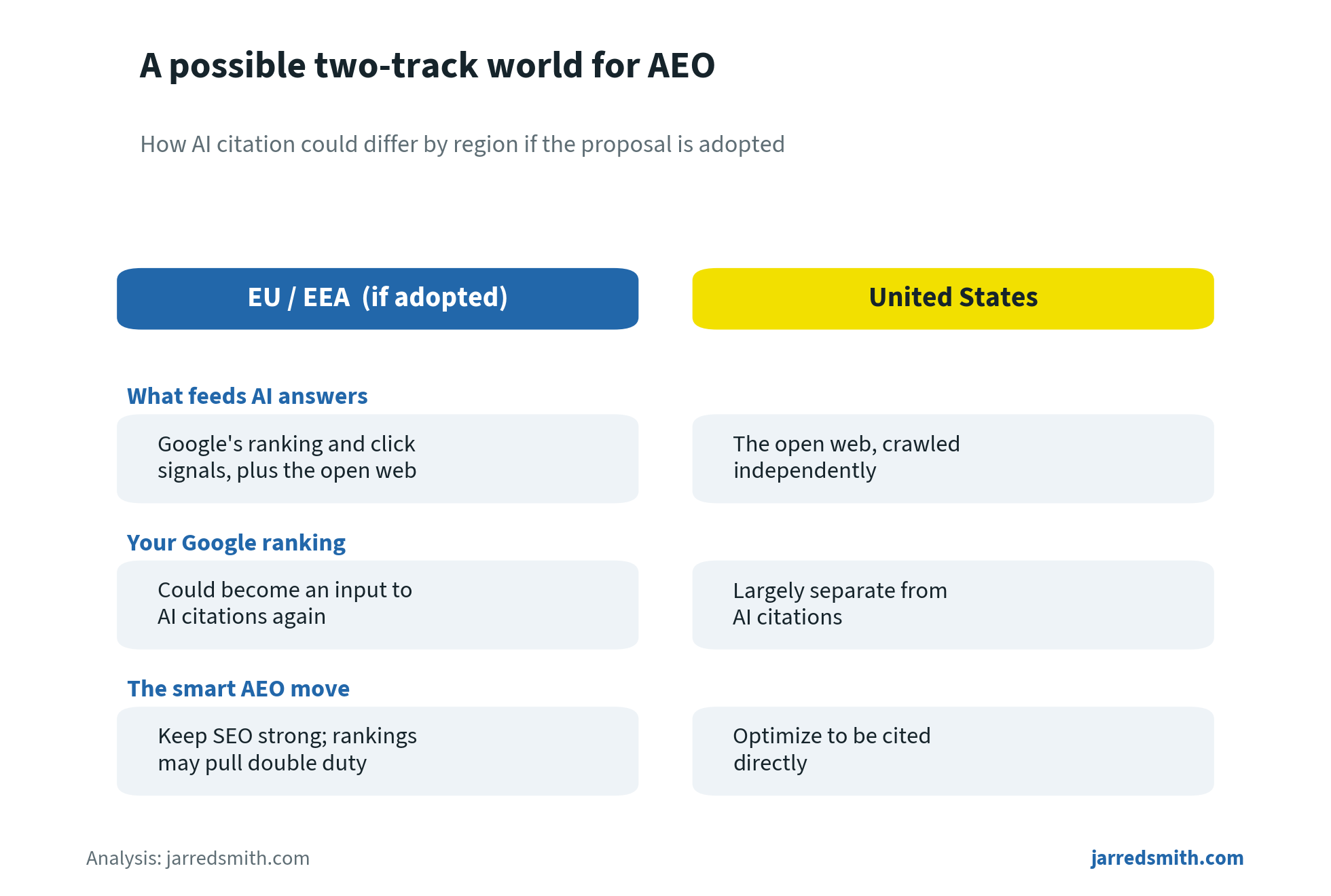
In Europe, the old advice and the new advice would start to rhyme. You keep your Google rankings strong because they might pull double duty, feeding both classic search and the AI answers that read Google's signals. In the US, the decoupling I've documented keeps going, and you optimize to be cited directly by engines building their own view of the web. That would leave a global brand running two playbooks at once, divided by geography. If I was in that position, I’d want to be prepared for any potential wrinkles in my operation before it shows up.
What I'd do before July 27
Nothing dramatic, which is almost always the correct starting point. Keep your SEO fundamentals in good shape, because there's now a regulatory scenario where Google rankings gain importance and none where letting them rot does you any good. Watch the July 27 decision specifically for whether AI chatbots stay on the eligibility list, since that single line decides whether any of this reaches AEO. If you sell into Europe, start splitting your AI-citation tracking by region now, so that if the two tracks diverge you can see it in your own numbers instead of guessing later. Keep doing the direct citation work that pays off no matter how Brussels rules. Having a trustworthy source is, and always will be, the asset that survives.
What keeps me on this is that it goes straight at the question my book is about, which is why an AI decides to recommend one brand and ignore another. That decision runs on inputs, and we mostly treat those inputs as fixed, as if the model crawled the web once, formed a view, and that was that. The EU is about to test whether a regulator can reach in and change the inputs by hand, feeding Google's hard-won signals into everyone else's models. Whether or not this exact proposal sticks is the game now. The inputs to the recommendation are up for grabs, and they're being settled in consultation documents as much as in your content. I'd keep one eye on July 27.
Jarred Smith is the author of Explainable: Why AI Recommends Some Brands & Ignores Others, an Amazon bestseller on AEO, GEO, and SEO. He's a marketing leader with nearly 20 years of experience across healthcare, public media, retail, and environmental services. Find him at jarredsmith.com.