
The Click Survived Checkout
For about a year, the confident prediction in this corner of marketing has been that the buy button is moving into the chat. Ask the assistant, get the answer, tap once, done, and the merchant's website becomes a warehouse with a URL. I gave that prediction a push myself. Back in May I wrote up Google I/O under the headline the end of the click-driven web, and watching Universal Cart follow shoppers across Search, Gemini, YouTube, and Gmail, the transaction looked like it was headed inside the assistant for good.
Then the first full year of agentic checkout produced its data, and the click held the exact spot everyone said it would lose first. Shoppers let AI find the product, compare the options, and make the case. When it's time to pay, they leave the chat and finish on the merchant's own site, and the numbers behind that behavior are lopsided enough that the biggest players have already rebuilt their plans around it. Since I helped hype the other version, I owe you the correction, with the receipts.
Ten months, start to finish
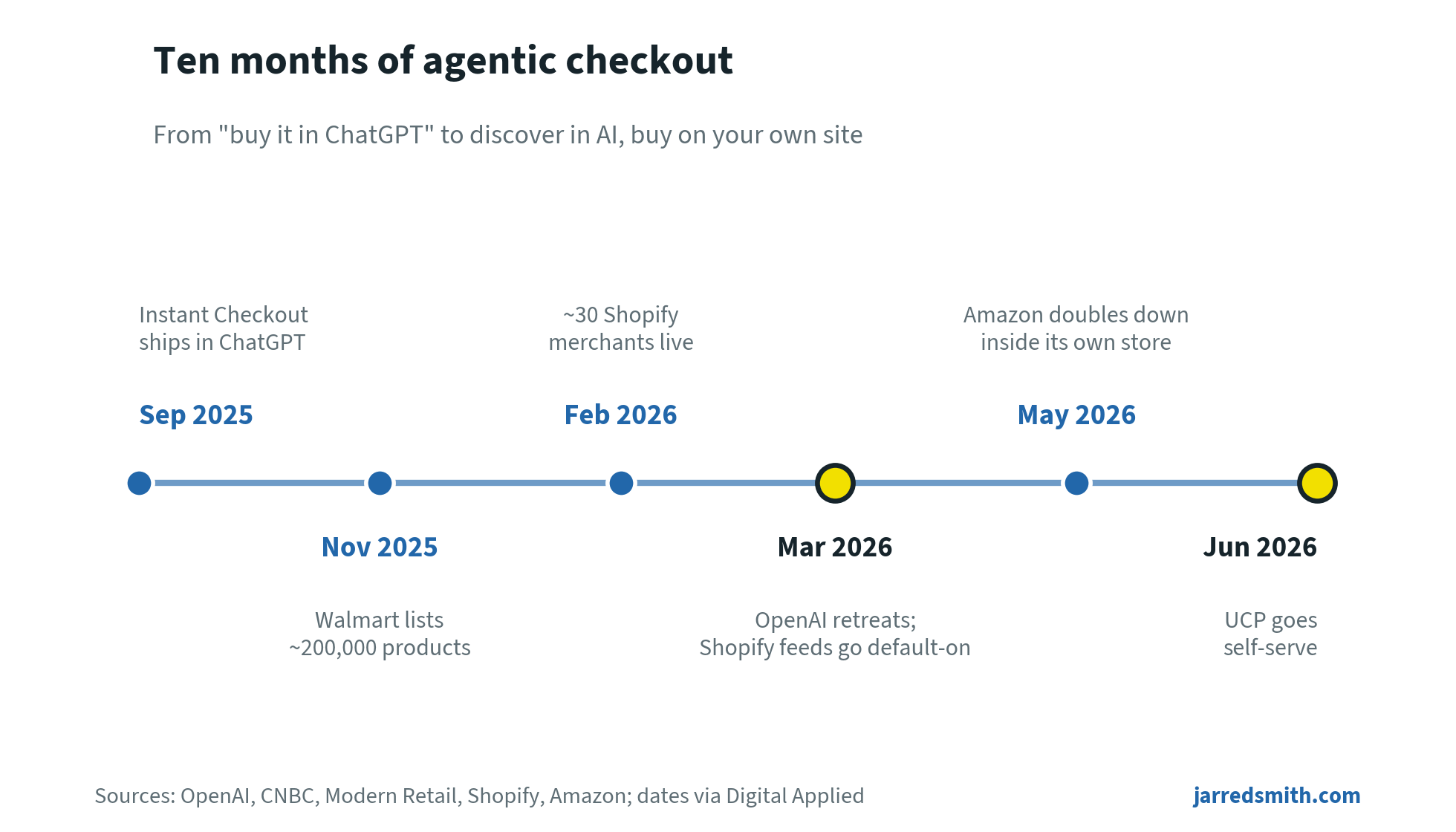
OpenAI launched Instant Checkout inside ChatGPT on September 29, 2025, running on the Agentic Commerce Protocol it open-sourced with Stripe. The launch supported single-item purchases from U.S. Etsy sellers, with over a million Shopify merchants, names like Glossier, SKIMS, and Vuori, promised as coming soon (Forbes). PayPal signed on in October to bring its merchant network along (PayPal). Walmart put roughly 200,000 products on it in November. The frontier language was everywhere.
By February, roughly 30 Shopify merchants were live, against the million promised, per Forrester's Emily Pfeiffer (Digital Applied's ten-month synthesis, which pulls the dated reporting into one place). Gartner's Bob Hetu read it as OpenAI underestimating how hard transaction enablement would be, and the tax detail backs him up: as of February, OpenAI hadn't built systems to collect and remit state sales tax, which tells you how much volume there was to remit (Forbes). In early March, The Information reported the pullback, and OpenAI confirmed that Instant Checkout was "moving to Apps," with purchases happening through connected retailer apps like Instacart and Target rather than natively in the chat (Digital Commerce 360). Walmart's Daniel Danker told a Morgan Stanley conference the in-chat experience was a temporary moment and predicted it would be gone within a month.
Walmart ran the experiment for everyone
The most useful numbers of the whole arc came out of Walmart's run, because 200,000 products on real traffic is a test the rest of us couldn't buy.
Completing checkout inside ChatGPT converted at about one-third the rate of sending the same shoppers to walmart.com to finish, per Danker's figures as reported by CNBC and Search Engine Land. The same traffic showed ChatGPT driving roughly twice the new-customer rate Walmart sees from search engines (Digital Applied).
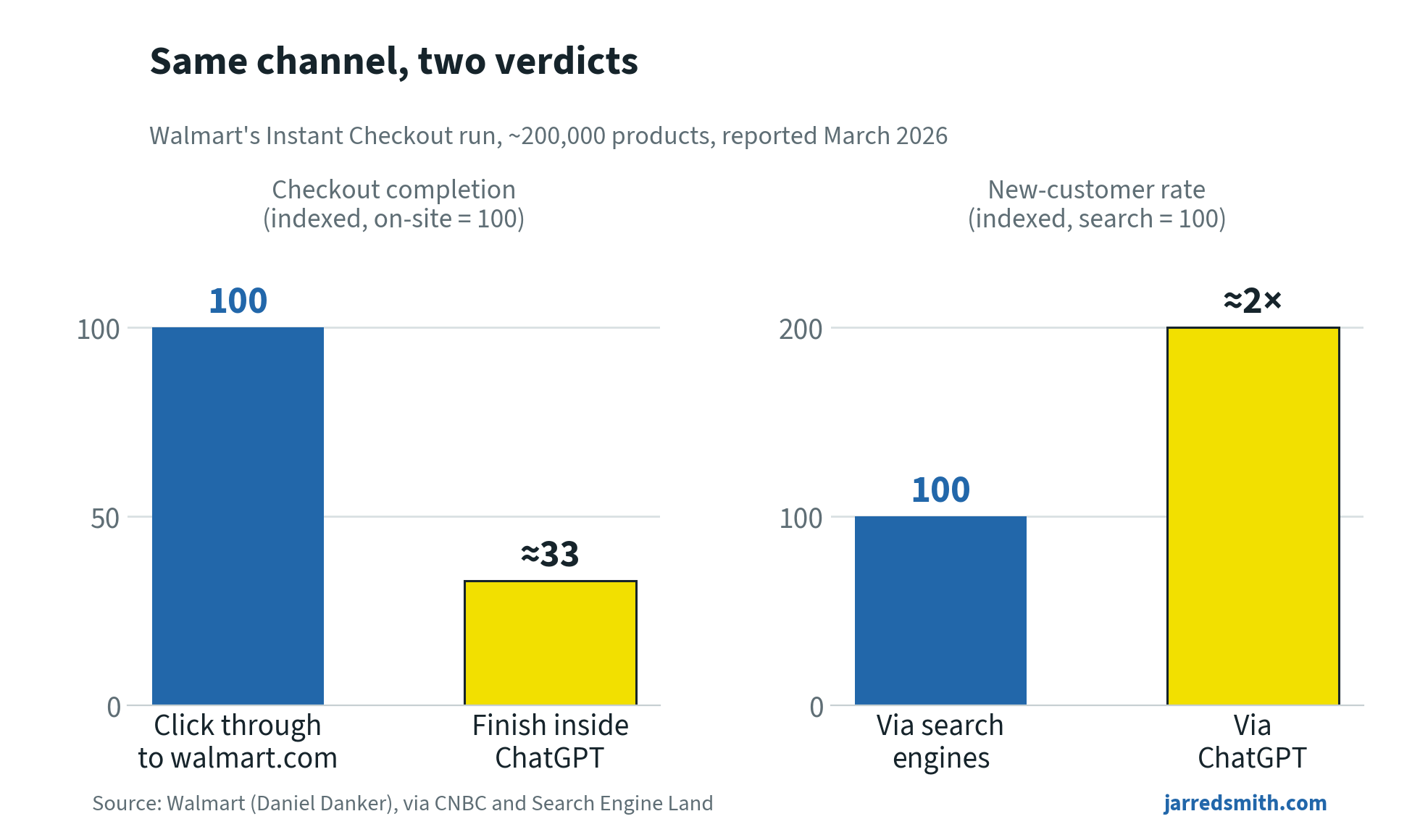
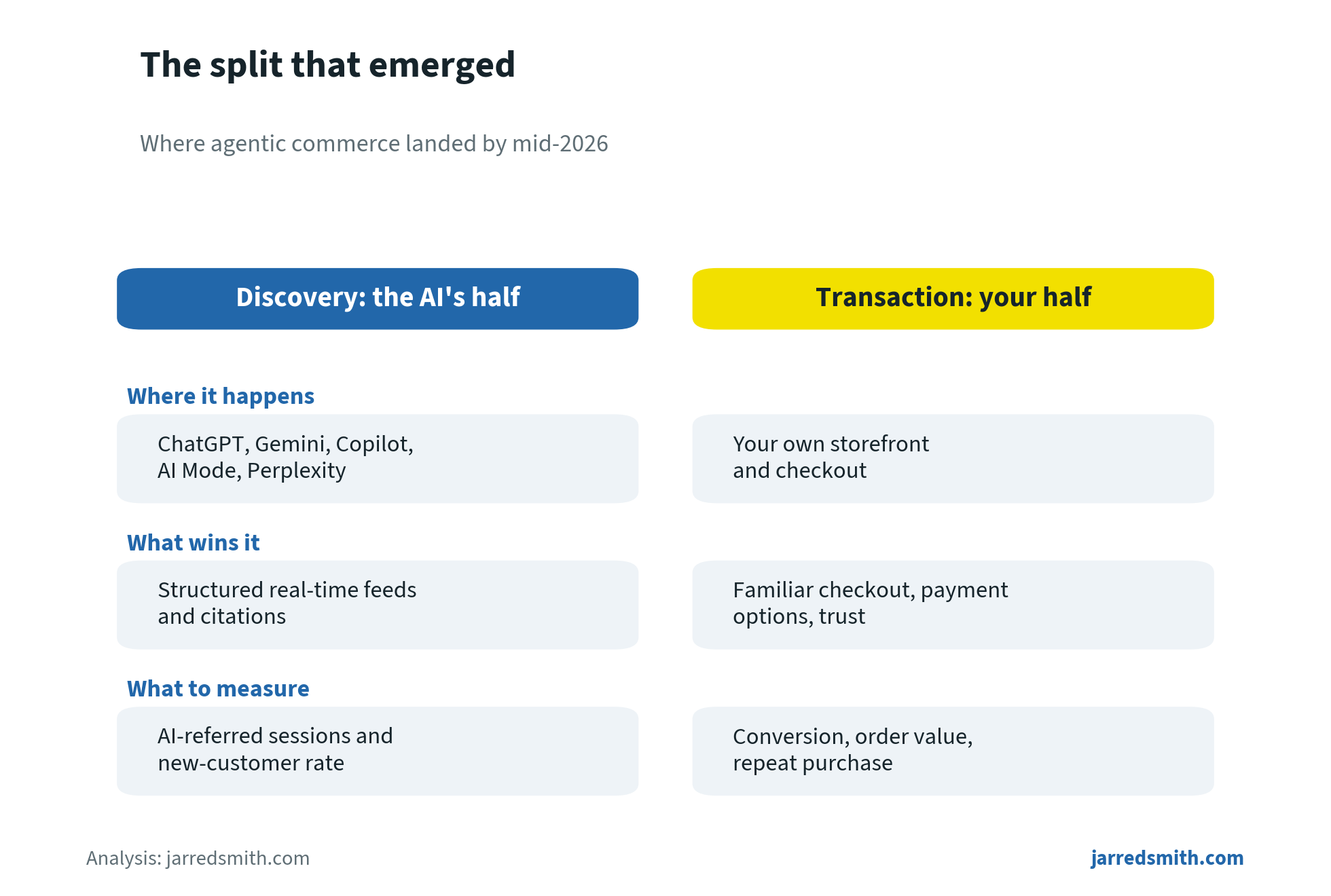
Sit those two numbers next to each other and the whole year makes sense. The assistant turned out to be a strong discovery channel and a weak cash register, in the same experiment, on the same shoppers. Which verdict you saw depended entirely on which half of the funnel you were measuring, and for six months most of the industry was measuring the wrong half.
What shoppers told the surveys
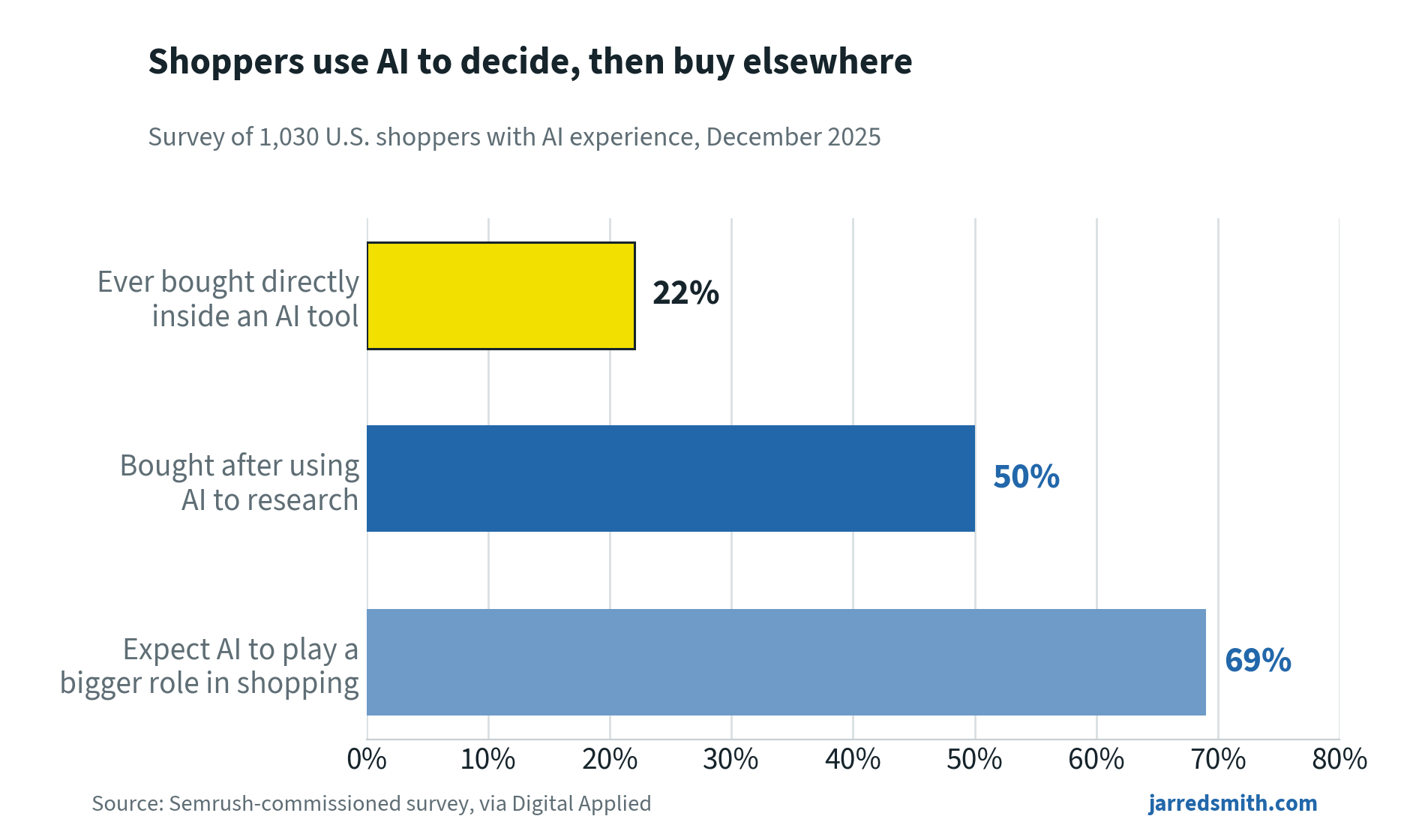
The consumer research says the Walmart pattern generalizes. A Semrush-commissioned survey of 1,030 U.S. shoppers with AI experience, fielded in December, found half had bought something after using AI to research it, while 22 percent had ever completed a purchase inside an AI tool, and 69 percent expect AI to play a bigger role in how they shop (Digital Applied). Forrester's own tracking described U.S. adoption of Instant Checkout as "low and stagnant" from debut to discontinuation (Forrester).
None of that means AI shopping is small. IBM's January study put 45 percent of consumers using AI somewhere in the buying journey (Paz), and Adobe measured a 4,700 percent year-over-year jump in generative-AI traffic to U.S. retail sites through July 2025 (Eco's 2026 guide). The behavior is enormous. The in-chat purchase is the thin slice of it, and Semrush's Leigh McKenzie points at why: catalog data across tens of millions of SKUs is a decade-scale infrastructure problem, and shoppers default to checkout flows they already trust (TechRound).
The rebuild happened around feeds
The infrastructure half of that diagnosis got fixed with surprising speed, just not in the direction of in-chat checkout.
Pfeiffer traced much of the failure to input quality, since agents were scraping retailer pages and quoting stale stock, delivery, and shipping data: "crawling and scraping is inadequate to get the full breadth of product data" needed to do commerce well. The fix is the structured feed. Google and Shopify launched the Universal Commerce Protocol in January with more than 20 backers, added real-time Catalog queries and multi-item carts in March, and Shopify flipped Agentic Storefronts on by default the same month, making products from 5.6 million stores discoverable across ChatGPT, Copilot, Google AI Mode, and Gemini. Microsoft wired UCP into Merchant Center in April, American Express shipped agent purchase protection the same month, and by Shopify's Spring release in June the approval requirement was gone entirely; any developer can self-serve against a public endpoint (Digital Applied, Paz).
Shopify's own numbers around this deserve their labels. Shopify reports that AI searches routed through its Catalog convert about twice as well as ones relying on scraped data, and cites AI traffic up 7x and AI-attributed orders up 11x since January 2025. Those are self-reported and unaudited, and the single-merchant stories that travel with them, one brand at 3.2 percent of monthly revenue from AI channels, another at 20x year-over-year, are existence proofs rather than benchmarks. I'd treat them as directionally consistent with the independent data and nothing stronger.
Amazon went the other way
One platform read the year differently, and the exception is instructive. In May, Amazon renamed Rufus to Alexa for Shopping and shipped agentic purchase features in earnest: Auto-Buy triggers when a tracked item hits your price, Buy for Me has Amazon transact on your behalf on other retailers' sites, and price history runs back a year. Amazon says Rufus helped over 300 million customers in 2025. At the same time, Amazon sued Perplexity over its Comet browser shopping on amazon.com and has blocked dozens of outside agents from transacting there (Digital Applied).
Both moves follow one rule, and it's the same rule driving everyone else toward their own storefronts. The transaction stays close to whoever owns the customer relationship. Amazon owns its shoppers, so checkout stays inside its walls and rival agents stay out. For every brand that isn't Amazon, that identical instinct points at your own site, which is why the year ended with the industry shorthand Digital Applied uses as its headline pattern: discover in AI, buy on site.
What I'd do with this
Publish a structured, real-time product feed and stop letting agents scrape you. On Shopify that's largely toggles now, Catalog plus Agentic Storefronts, and on other platforms it's supporting UCP or ACP through whatever your stack exposes rather than hand-building integrations. The feed is the one input you fully control, and it's the input the year's reporting says moved conversion.
Keep the checkout on your site, and treat the click-through as an asset instead of friction to eliminate. The completion advantage lives there, roughly three to one in Walmart's data, along with the payment relationship, the post-purchase flow, and the customer record. Handing those to an assistant was the year's expensive lesson, and the retailers who ran the test came back for their registers.
Measure the channel by its discovery value. AI-referred sessions and new-customer rate are where the money showed up; Walmart's two-times acquisition number would be invisible in a last-click report, and I suspect a lot of brands are undervaluing the channel right now for exactly that reason.
Re-check the board quarterly. The self-serve change is a month old, the protocols are moving monthly, and if the year proved anything it's that launch promises and adoption are different animals.
The half of agentic commerce that works is the recommendation half, and that's the territory I spent a book on. Explainable is about why an AI puts one brand in the answer and leaves another out, and this year's checkout data raised the stakes on that question instead of retiring it. The purchase still finishes on your storefront, so the AI's recommendation is now the doorway to a register you kept, and at Walmart that doorway brought twice the new customers. Getting named in the answer decides who walks through. The register, it turns out, never had to move.
Jarred Smith is the author of Explainable: Why AI Recommends Some Brands & Ignores Others, an Amazon bestseller on AEO, GEO, and SEO. He's a marketing leader with nearly 20 years of experience across healthcare, public media, retail, and environmental services. Find him at [jarredsmith.com](https://jarredsmith.com).