
Google I/O 2026 and the End of the Click-Driven Web
I watched the Sundar Pichai keynote yesterday morning expecting the usual rhythm. A few model benchmarks, a couple of consumer demos, some developer plumbing, and maybe one feature that would matter for marketers in around eighteen months. That’s been the pattern at Google I/O for a decade, and you take notes, write a quick reaction, and move on. This time, it didn’t fit that pattern at all.
The headline announcements all looked familiar enough on the surface. Gemini 3.5 Flash became the default model in AI Mode globally, the search box itself got rebuilt for the first time in a quarter-century, persistent background AI agents arrived in Search, Universal Cart was unveiled with Shopify and twenty other commerce partners, and Business Agent gave eligible retailers their own branded chat surface inside Google results. None of those, taken in isolation, would have changed my day.
Taken together, they read to me as something more architectural. Google is conceding, in the careful way Google concedes things, that the link-based web is finishing. The Search experience the company described in roughly ninety minutes is one where, increasingly, the user never leaves Google to find your brand. They get an answer, they compare options, they buy, and your brand either showed up inside that answer or it didn’t.
I’ve been writing about this transition for a year, mostly in the context of AEO and GEO, and I thought I had a reasonable grip on where it was headed. After watching the keynote and reading through the supporting blog posts, the analyst takes, and the technical documentation Google dropped four days before the event, my real read is that the timeline I’d been describing to people is shorter than I thought.
The shifts that matter for brand discoverability
Most of the I/O coverage focused on Gemini 3.5 Flash’s benchmarks and a fun demo where Google Search builds you a custom mini-app on the fly. Those are real and they’re worth covering, but they aren’t the part that should worry marketing leaders. Five other shifts will, and they compound on each other.
Gemini 3.5 Flash is now powering AI Mode globally, and AI Mode itself crossed a billion monthly active users in twelve months. Liz Reid, VP and Head of Search, said queries are “more than doubling every quarter since launch,” that overall Google Search queries hit an all-time high last quarter, and that AI Overviews now serves 2.5 billion monthly users. The thing some marketers were calling experimental six months ago is now the default experience for a billion people.
The search box itself got rebuilt for the first time in twenty-five years. Reid called the new “intelligent Search box” the biggest upgrade since its debut in 2001. It dynamically expands as you type, accepts text, images, files, videos, and open Chrome tabs as input, and uses Gemini-powered suggestions that go well beyond autocomplete. Barry Schwartz at Search Engine Land summed up the brand-discoverability implication in one understated line, noting that it might lead to fewer clicks to your website than before.
Information agents are now part of Search. These are persistent, 24/7 AI agents that monitor the web on a user’s behalf. Reid’s stage example showed a finance use case where a user could ask the agent to track market movements in a sector with specific parameters, and the agent would map out its own monitoring plan, pick the tools and data sources it needed, and report back. Information agents launch this summer for Google AI Pro and Ultra subscribers, with agentic booking and “call businesses on your behalf” capabilities rolling out broadly to U.S. users in the same window.
Universal Cart and the Universal Commerce Protocol (UCP) collapse discovery, comparison, and checkout into Google’s own surfaces. Vidhya Srinivasan, VP/GM of Ads and Commerce, announced an intelligent shopping cart that follows users across Search, Gemini, YouTube, and Gmail. It runs on Google Wallet, surfaces price history, finds card perks, and supports one-tap checkout with Nike, Sephora, Target, Ulta Beauty, Walmart, Wayfair, and Shopify merchants such as Fenty and Steve Madden. UCP was co-developed with Shopify and endorsed by more than twenty companies including Etsy, Adyen, American Express, Best Buy, Stripe, Visa, Mastercard, Macy’s, The Home Depot, and Zalando, and it functions as the connective tissue Google is building for agentic commerce. The companion Agent Payments Protocol (AP2) provides cryptographic mandates so agents can transact on a buyer’s behalf within guardrails.
Business Agent and Direct Offers create new branded surfaces inside Search itself. Business Agent, already live with Lowe’s, Michael’s, Poshmark, and Reebok, gives eligible U.S. retailers a branded AI chat experience directly inside Search results, functioning as a virtual sales associate trained on your merchant data, customizable in Merchant Center with your logo, brand colors, voice, and conversation starters. Direct Offers, a Google Ads pilot inside AI Mode, lets retailers like Petco, e.l.f. Cosmetics, Samsonite, Rugs USA, and Shopify merchants surface exclusive discounts to high-intent shoppers.
A sixth piece I’ll mention but won’t dwell on is Gemini Spark, Google’s bid for the always-on personal agent that lives on a dedicated cloud VM, accepts tasks via its own Gmail address, and will soon run inside Chrome as an agentic browser. Spark deserves its own post once it’s broadly available. The piece to register for today is that by summer, “the agent runs in your browser and does the searching for you” stops being a research paper and starts being a Chrome feature for paying customers.
Add all of that up and what Google announced is a Search experience where users describe whole situations, get a synthesized response built specifically for them, and either find your brand inside that response or never see it at all. Five compounding shifts in a single keynote.
What the data underneath the announcements says
The data underneath those keynote talking points is where the case for changing strategy lives, and three numbers from the research have stuck with me in particular.
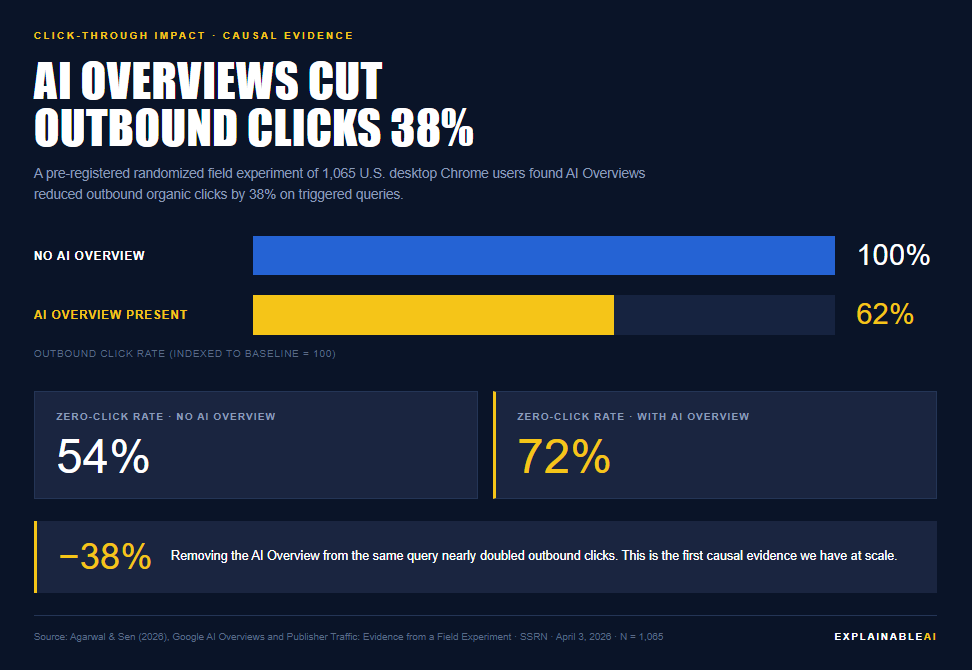
One is the 38% drop in outbound organic clicks on triggered queries when AI Overviews appears, measured in a pre-registered randomized field experiment by Saharsh Agarwal at the Indian School of Business and Ananya Sen at Carnegie Mellon. They recruited 1,065 U.S. desktop Chrome users through Prolific, registered the design with the AEA RCT Registry, and posted the paper to SSRN on April 3, 2026. Zero-click searches in their sample went from 54% to 72% when an AI Overview was present, and removing the AI Overview from the same query nearly doubled outbound clicks. This is the first causal evidence we have at scale that AI Overviews depress click-through.
Then there’s the Adobe Digital Insights data, published April 16, 2026 by Vivek Pandya. Adobe tracked more than a trillion visits to U.S. retail sites and found AI traffic grew 393% year-over-year in Q1 2026, and that AI-referred traffic now converts 42% better than non-AI traffic, up from converting 38% worse a year earlier. That’s a structural reversal in a single year. AI-mediated discovery has stopped being the weird experimental traffic source your analytics team flagged with a question mark, because in many retail verticals it’s now converting better than the channels you’ve been treating as core.
And then there’s SISTRIX. Their February 2026 monthly review, published March 1 by founder Johannes Beus, analyzed more than 100 million keywords in the German market. On queries where AI Overviews appears, the position-one organic click-through rate dropped from 27% to 11%, which SISTRIX estimates at 265 million lost organic clicks per month in Germany alone. I cite the German market here because SISTRIX measures it more thoroughly than anyone measures the U.S. market, and the pattern shows up wherever equivalent data exists.
All three of these studies were completed and published before yesterday’s keynote, in a world without Gemini 3.5 Flash, Universal Cart, information agents, or a billion-MAU AI Mode. The traffic loss they document is the baseline that existed already, and yesterday’s announcements are the accelerant layered on top.
There’s a counterweight in this data I think should be named. The same Adobe analysis showing 393% AI traffic growth also shows that AI traffic is still a small percentage of total ecommerce visits in absolute terms, and Rand Fishkin’s Q1 2026 Datos/SparkToro analysis puts AI Mode’s share of total query volume at well under 0.2%. Traditional search is still where most of the queries are. You can read the data two ways. One reading is that this is a structural shift that hasn’t yet shown up in your top-line numbers, and the other is that the story has been overhyped because the absolute share is small. I keep coming back to the same answer when I look at it, which is that share-of-query is the wrong measurement frame for this moment. Decisions are moving through AI surfaces faster than queries are, and decisions are what marketing has to influence.
How retrieval is changing, and why that changes who gets cited
Underneath the keynote talking points sits a structural change in how AI Mode answers questions, and it matters more than any single product announcement.
When you type a query into AI Mode, Google doesn’t run that query and return the top ten results. It runs something called query fan-out. Your single query gets broken into up to sixteen parallel sub-queries that retrieve passages across topics and data sources before synthesizing an answer. Mike King at iPullRank, Search Engine Land’s 2025 AI Search Marketer of the Year, has been the loudest practitioner voice on what this means, and his I/O-week framing is worth paraphrasing closely. King argues that Google’s AI is probably reaching across rankings for a different set of background queries rather than reaching far down the rankings for a single keyword. So while marketers track position for “best car insurance,” Google may be selecting a passage based on how well it ranks for “GEICO vs. Progressive comparison chart for new parents.” Per King, ranking number one for the core query gives you roughly a 25% chance of being cited inside the corresponding AI Overview.
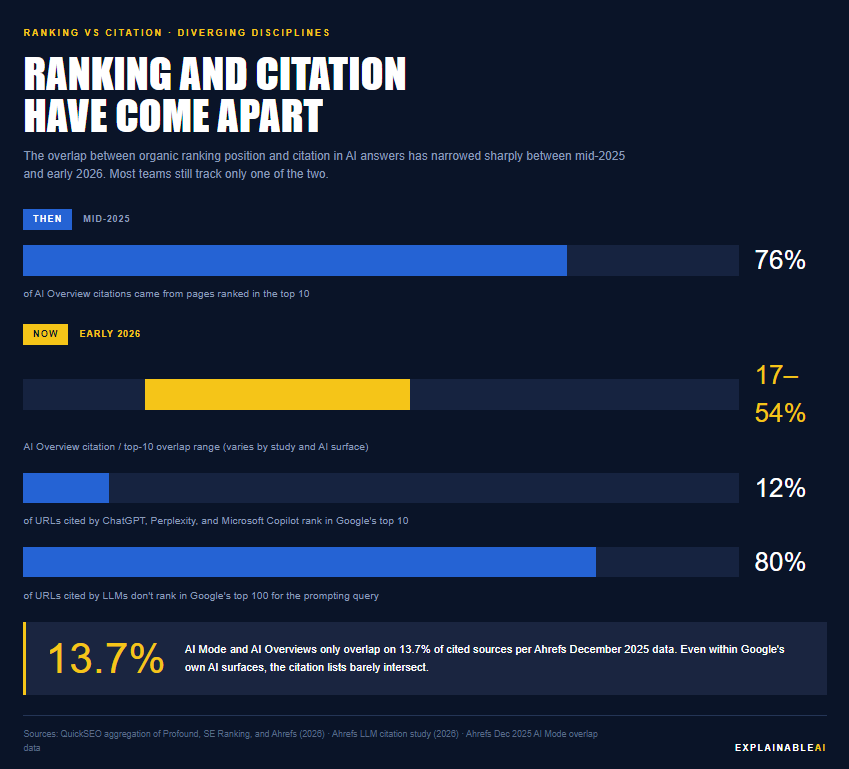
The citation pool has widened well beyond the top ten as a result. In mid-2025, around 76% of AI Overview citations came from pages ranked in the top ten. By early 2026, research aggregated by QuickSEO from Profound, SE Ranking, and Ahrefs put that overlap somewhere between 17% and 54%, depending on which study you used and which AI surface you measured. Ahrefs analysis I covered in the AEO Practitioner’s Playbook found that 80% of URLs cited by LLMs don’t rank in Google’s top 100 for the prompting query, and only 12% of URLs cited by ChatGPT, Perplexity, and Microsoft Copilot rank in Google’s top 10. AI Mode and AI Overviews themselves only overlap on 13.7% of cited sources per Ahrefs December 2025 data. Ranking optimization and citation optimization have become separate disciplines, with little enough overlap between them that they now need separate tracking, and most teams are still only tracking rank.
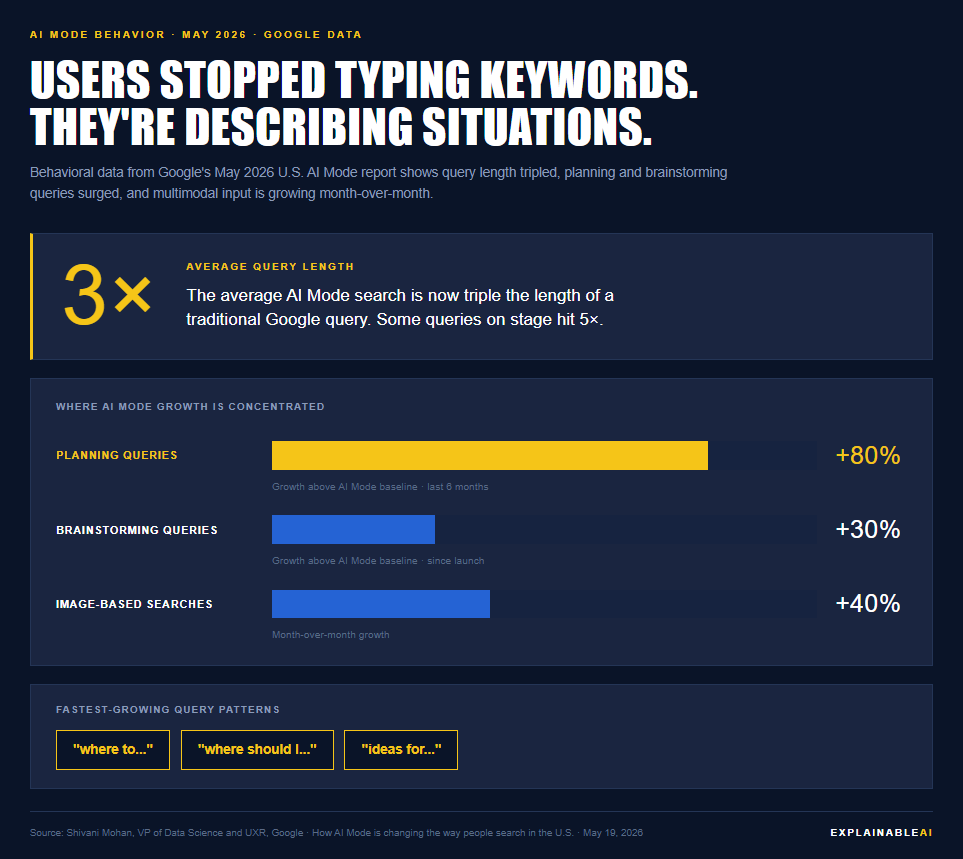
The behavioral data from Google’s own post on how AI Mode is changing U.S. search reinforces the point. Shivani Mohan, VP of Data Science and UXR, reported that the average AI Mode search is triple the length of a traditional Search query, and Pichai said on stage some queries are five times as long. AI Mode planning queries have grown 80% faster than AI Mode queries overall in the past six months. Brainstorming queries have grown 30% faster, and searches starting with “where to,” “where should I,” and “ideas for” are the fastest-growing patterns. More than one in six U.S. searches now use voice or images, with image searches growing over 40% month-over-month.
What that tells you is that users have stopped compressing intent into two-to-four keywords and started describing whole situations, with constraints and tradeoffs included. Content that wins fan-out retrieval engages with the context the user provided rather than ignoring it. Most of the content briefs I still see treat the user as if they asked a four-word question.
What Google itself published four days before the keynote
One thing the keynote coverage mostly missed deserves its own section, because it’s the strongest single signal Google has ever given marketers about how to approach AI search.
Four days before Pichai took the stage, on May 15, 2026, Google published its first consolidated guidance on optimizing for generative AI features in Search, on the official Search Central site. The guide bounds the entire AEO and GEO conversation Google wants you to have, and the timing wasn’t an accident.
A few lines from that guide are worth pulling out. From Google’s perspective, optimizing for generative AI search is optimizing for the search experience, and thus still SEO. Google says you don’t need an llms.txt file, because it doesn’t process one specially, and you don’t need to chunk content for AI either, because Google parses full pages and extracts relevant passages on its own. Inauthentic brand mentions, the kind seeded across forums, listicles, and social posts, are explicitly flagged as risky and now fall under Google’s updated spam policy, which on the same day was expanded to cover “attempting to manipulate generative AI responses in Google Search.” Schema.org structured data remains valuable for rich results but isn’t specially required for AI responses.
The practitioner reactions split immediately. Aleyda Solis at Orainti summarized the main point cleanly as a call to create valuable, non-commodity content for your audience. Glenn Gabe at G-Squared Interactive emphasized the mythbusting section, while Lily Ray translated the “inauthentic mentions” language as classic Googlespeak that probably covers listicle pages and paid or reciprocal brand mentions, though she noted Google wasn’t explicit about which.
Mike King’s counter-argument, published the day before the keynote, is the one CMOs should read alongside Google’s guide rather than instead of it. King argues that Google’s framing serves Google’s platform interest, and points to Microsoft’s Bing team having published a more technically transparent view in which the unit of value shifts from documents to groundable information with clear provenance. His broader frame is the one I think marketers should internalize. SEO was built around earning visibility that converts into clicks, while AI search is built around supplying information that can be extracted, trusted, and reused without a click ever happening. Marketers keep optimizing for rankings and traffic while the system optimizes for reliability, composability, and downstream usefulness.
Both views are correct, and both should be on your desk. Read Google’s guide as the bounded operating manual for the surface you can’t ignore, then read King to make sense of why your traffic graph is doing what it’s doing regardless of what’s in that manual.
What marketers should do
After sitting with the announcements and the data for a day, I’d organize the work into three tiers, by urgency rather than complexity. None of it requires throwing out what you’re doing today, though it does mean accepting that the reporting frame most marketing teams are running on right now is no longer fit for purpose.
Tier one is protecting what you already have, inside the next thirty days. Pull Search Console, filter your top queries by impressions, and find every query where impressions are rising but clicks and CTR are falling. That gap is where AI Overviews are absorbing your traffic, and the fix is to restructure those pages so they lead with a direct answer in the first 100 words. A passage that answers the question directly is more likely to be selected by query fan-out than a paragraph that buries the answer in marketing copy. While you’re at it, audit your Google Business Profile and Merchant Center feeds, because the new Merchant Center attributes Google announced are the entry ticket for AI Mode, Gemini, and Business Agent discoverability. And reset how you report to leadership; year-over-year traffic comparisons against pre-AI baselines mislead more than they inform now, and adding an “AI-feature share of query” cut and an “AI citation rate” metric to your weekly dashboard is a one-week project that changes the conversation materially.
Once that protection layer is in place, you can build citation authority over the next six months. Add AI citation tracking across AI Mode, AI Overviews, ChatGPT, Perplexity, and Copilot to your reporting stack; tools like Profound, Semrush, Ahrefs, BrightEdge, and Otterly all do versions of this. Treating citation frequency as a primary KPI alongside rank stops being aspirational the moment Google’s own data shows the two are different disciplines. Invest in content only your team can produce, the kind that includes original research, named case studies, proprietary frameworks, and practitioner-led data. Google’s May 15 guide is unusually explicit that commodity content earns no citation value, and the I/O announcements are equally explicit that commodity inventory will be summarized away inside Google. Build topical depth rather than isolated keyword pages, since fan-out retrieval rewards clusters that cover a topic from multiple angles. Strengthen entity presence across credible external sources like industry publications, structured databases, and podcast appearances, because branded mentions across the web correlate with AI Overview appearances about three times more than backlinks per Position Digital’s April 2026 data.
The longest-horizon tier, the one that pays off through 2027, is investing in agent-readiness. Apply for Business Agent eligibility in Merchant Center if you’re a qualifying U.S. retailer, because the customization is free today and structurally advantages early adopters before competitors notice it exists. Audit your DOM and rendering, because Google’s May 15 guide notes that browser agents access sites via screenshots, DOM inspection, and the accessibility tree, and JavaScript-rendered key specs are a known failure mode for agents. Derick Do at Launchcodex summarized the data hygiene gap precisely. Most brands have plenty of content; what they lack is reliable infrastructure underneath it, with pricing that’s six months out of date, booking flows that break on mobile, and product pages that rely on JavaScript to render the key specs. Agents will skip or misread all of it. If you sell physical or digital products, get on the UCP roadmap; the protocol is live, the GitHub repo is open, and the eligible-merchant pilot is short-listing competitors right now. Build first-party data and authenticated audience relationships, because Personal Intelligence personalizes based on Gmail, Photos, and Calendar, which structurally favors a brand a user has already engaged with over a cold-keyword competitor.
There are also things to stop doing, which I’d put under a fourth implicit tier I’ll call “don’t pay consultants for tactics Google just said don’t work.” That category covers creating llms.txt files, chunking content into AI-formatted snippets, seeding inauthentic brand mentions across forums or listicles, and over-engineering structured data. Every one of those tactics carries downside risk under Google’s updated spam policy now, and most were sold as paid consulting deliverables somewhere in the last six months. The floor moved.
What I’m still uncertain about
I’d be doing you a disservice if I closed without flagging what I’m not sure of, because some of this is fresh enough that anyone claiming they have it figured out at this point is performing.
I don’t know how aggressively the EU regulatory environment will constrain the personalization layer. The European Commission’s April 2026 measures under the Digital Markets Act require Google to share anonymized search data with rival search engines and AI chatbot providers, with a July 27, 2026 compliance deadline. How that interacts with Personal Intelligence and Business Agent rollouts in the EU is unclear, and CMOs with European footprints should be tracking it closely.
I’m also not sure how the competitive layer shakes out. Gemini 3.5 Flash isn’t claiming the absolute intelligence frontier, and independent benchmarker Artificial Analysis scores it at 55 on its Intelligence Index, a nine-point jump over Gemini 3 Flash but still behind GPT-5.5 on some agentic workflow benchmarks and behind Claude Opus 4.7 on SWE-bench Verified with higher hallucination rates. Its strongest argument has more to do with price-performance and distribution than with raw capability. Meanwhile, Perplexity’s ARR crossed $450 million in March, more than doubling in a quarter after Perplexity Computer launched, and OpenAI confirmed ChatGPT crossed 900 million weekly active users in February. Brand strategies that assume one AI search platform will win outright are misreading the market. The pragmatic move is to optimize primarily for Google AI Mode and AI Overviews because the reach is biggest, while treating ChatGPT, Perplexity, Copilot, and Claude as independent retrieval surfaces with different signals.
There’s also a genuine question about whether Universal Cart works at the user-experience level. The product is announced, the rollout is staged across summer, and the merchant set is impressive but small. Whether shoppers tolerate buying through a Google cart instead of a brand site is empirical, and we’ll learn the answer between now and the holidays. If it works, the line between your brand site and your brand’s Google surface gets thin fast.
What I’m confident about is the direction. For a billion people, Search has moved past the era of typing a few keywords, scanning ten blue links, and clicking one of them. The replacement experience is closer to a conversation, where users describe their situations and receive a synthesized response built specifically for them, and where brands appear inside the response or go invisible.
What that shift means for marketers, practically, is a different job description than the one most teams have been operating against for the past decade. The harder work now is making your brand the kind of source these systems want to use, which means content your competitors can’t produce, infrastructure your agents can read without choking, citation tracking treated as a primary metric, and an honest conversation with your leadership about what the traffic graph is going to look like for the rest of 2026.
If you want the longer version of how to do that work, that’s what I wrote Explainable for. The book gives you the frameworks, the audit structure, and the implementation plan in more detail than I can fit into a single post.
For today, I’d settle for one thing from anyone reading this, which is to stop using last year’s reporting to make next month’s decisions. The Search your customers use has been changing under you for months, and Pichai made the new shape official yesterday morning.
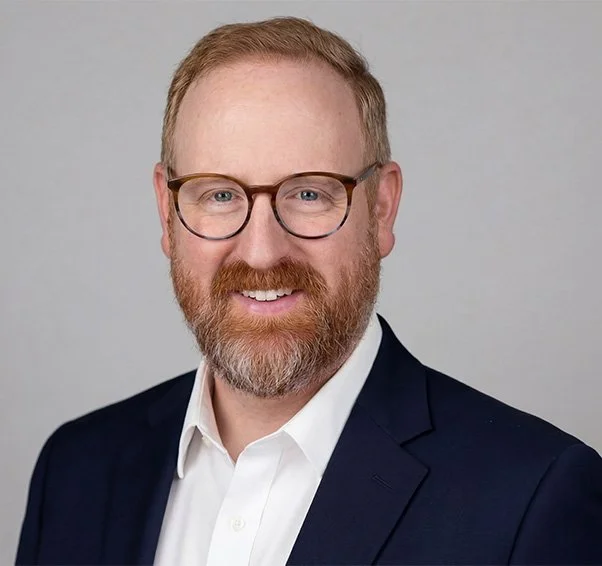
Jarred Smith is the author of Explainable: Why AI Recommends Some Brands & Ignores Others, an Amazon bestseller on AEO, GEO, and SEO. He’s a marketing leader with nearly 20 years of experience across healthcare, public media, retail, and environmental services. Find him at jarredsmith.com.