
AI Search Visibility in 2026: What the Data Says, What’s Working, and Where Most Brands Are Still Lost
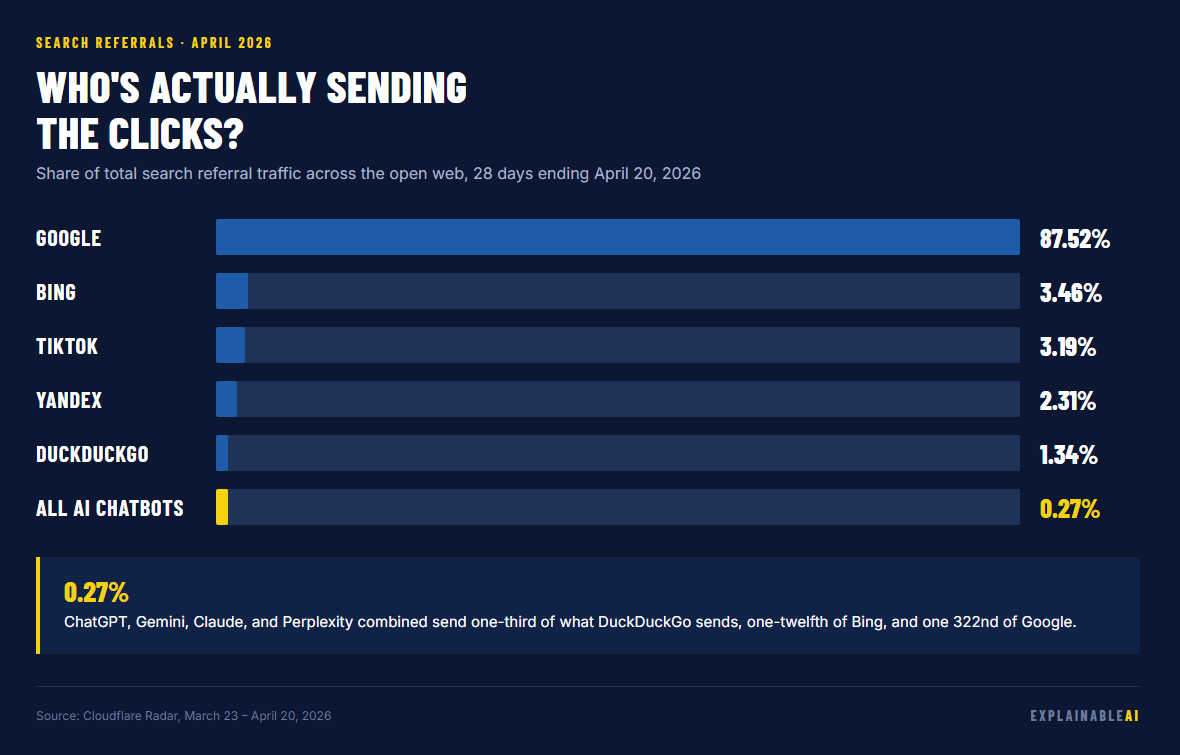
In April 2026, Cloudflare’s referral data showed every AI chatbot combined sent 0.27% of search referral traffic. Google sent 87.52%. If you read only that line, you’d conclude the AI search panic has been wildly overblown.
In the same month, Seer Interactive analyzed 25.1 million Google AI Mode impressions and found 93% of them produced zero outbound clicks. A separate randomized field experiment by Agarwal and Sen had already confirmed the mechanism: when AI Overviews appeared in front of users, organic clicks dropped 38% and zero-click rates jumped from 54% to 72%.
Those two findings sit next to each other and refuse to resolve into a single story. The chatbots themselves are barely sending clicks, while the AI layer Google bolted onto its own results page is steadily eating organic traffic across most informational categories.
I’ve spent the last six months working with marketing teams, consulting clients, and a SaaS product I’m building around this exact problem, and the thing that keeps coming up is that almost nobody has the picture right. Most teams have either decided AI search is the future and they’re pouring resources into ChatGPT optimization while their pipeline shrinks, or they’ve decided the referral numbers are too small to matter and they’re sleepwalking through a structural change to how their buyers find them.
This post is for the people in the middle. I’ll walk through what the data shows about AI search visibility in mid-2026, where the leverage is, what’s a waste of time, and how I think about it for my own clients. It’s long because the topic deserves it. If you want the short version: visibility, not traffic, is the metric that matters now; the brands winning are doing it through earned mentions, comparison content, and primary data; and most of what’s being sold as “AEO best practice” doesn’t survive contact with the studies.
The two numbers that should reshape your dashboard
Start with referrals, because that’s what most CMOs are still looking at when they ask “is AI search real?”
Cloudflare Radar’s data for the 28 days ending April 20, 2026 showed the breakdown of search referral traffic to websites. Google: 87.52%. Bing: 3.46%. TikTok: 3.19%. Yandex: 2.31%. DuckDuckGo: 1.34%. Every AI chatbot combined, ChatGPT plus Gemini plus Claude plus Perplexity: 0.27%.
That’s one-third of what DuckDuckGo sends. One-twelfth of what Bing sends. One 322nd of what Google sends.
You can read that two ways. The first is “AI search is a rounding error and we should stop talking about it.” That’s the read most agency RFPs are still operating from. The second read is the one the data supports, which is that AI tools are not yet a meaningful distributor of clicks, but they have become a meaningful distributor of attention. Those are different metrics.
Now look at the second number. Adobe Digital Insights measured AI-driven referral traffic to US retail sites and saw it grow 693% year over year during the 2025 holiday season. The same Adobe data showed AI referrals converted 31% better than non-AI traffic. Ahrefs reported AI search visitors made up 0.5% of all visitors but drove 12.1% of signups. Opollo’s 2026 benchmark of MSPs and tech companies showed AI accounted for 4% of sessions but 19% of qualified inbound pipeline.
This is the gap that breaks most dashboards. Volume is small, quality is unusually high, and growth rate is steep, which means a channel that looks invisible in a pie chart can be the second or third largest source of qualified pipeline once you weight by intent.
I keep going back to a thing I wrote about in Explainable around the difference between rankings and recommendations. Search engines used to rank, and the user did the picking. AI tools recommend, and the user usually does what the tool said. When a recommendation channel grows 600% in a year and converts at 4 to 5 times the rate of organic, the dashboard view of “0.5% of sessions” radically understates what’s happening to your funnel.
So that’s the first thing. The referral pie chart is the wrong place to start. The second thing is what’s happening inside Google itself, because that’s where most of the damage is showing up.
The zero-click problem is now structural
In 2019, SparkToro’s zero-click research showed about 50% of Google searches ended without a click. In 2024, the same kind of analysis put it at 58.5% in the US and 59.7% in the EU. In April 2026, Digital Applied reported 64.82%. The curve is still going up.
The reason is no mystery. Google rolled out AI Overviews to the US, then DACH, then most of Europe. BrightEdge and Ahrefs data show AI Overviews now appear on about 48% of all search queries as of March 2026, up 58% from December 2025. Ahrefs reported in November 2025 that 99.9% of informational keywords trigger an AI Overview. Then in March 2026, Google rolled AI Mode out to all US users, and AI Mode is the more aggressive product.
The Seer Interactive numbers on AI Mode are the ones that should make any informational publisher nervous. Across 25.1 million impressions, 93% of AI Mode searches ended without a single click to an external website. Compare that to roughly 43% zero-click for AI Overviews, and you can see the trajectory: as Google moves users from AI Overviews to AI Mode, the click rate falls off another cliff.
Agarwal and Sen’s randomized field experiment from early 2026 is the cleanest piece of evidence I’ve seen on the causal story. They randomly assigned 1,065 US participants to either see or not see AI Overviews during search over a two-week period. When AI Overviews appeared, organic clicks dropped 38%. Zero-click rates jumped from 54% to 72%. Removing AI Overviews did not change user satisfaction scores. Users did not miss them.
That last finding is the one I keep coming back to. Users are tolerating AI Overviews because Google ships them, without much regard for whether they prefer the AI summary over the old results page. No amount of content quality is going to pry users back if Google decides the AI answer is good enough.
What this means in practice, and I see this with consulting clients almost every week, is that the published case studies of sites losing 30% to 60% of organic traffic are a predictable result rather than a fluke. Any site that built its traffic on informational content where the question can be answered above the click is exposed to the same dynamic. HubSpot’s well-documented 70 to 80% traffic decline is the canonical example because they built an empire on glossary-style and how-to content. Those formats summarize cleanly. AI does not need to send the user anywhere to deliver the answer.
The corollary, and this is the part most teams miss, is that not all content collapses. Rand Fishkin’s April 2026 analysis of 400 sites that survived “the great traffic apocalypse” found five shared characteristics: strong brand searches, content that resists summarization (calculators, interactive tools, primary data), unique angles a model can’t reconstruct from training data, multi-surface presence beyond a single domain, and a clear reason for the user to click. The sites that collapsed were producing generic content that AI could disintermediate. The sites that survived gave the user something the AI answer couldn’t.
This is the architectural shift. The old SEO question was “how do I rank for this keyword.” The new question is “if Google’s AI answers this query, what’s left for me to win?” Sometimes the answer is “nothing, this is a query where AI gets the click and we get the citation.” Sometimes the answer is “we can still earn the click because the user has to use the tool itself.” Knowing which is which is the first move in any 2026 strategy.
Citations are the new rankings
If clicks are getting scarcer, what’s left? Citations. The mention of your brand or domain inside the AI answer itself, with or without a clickable link.
This is where the data gets interesting, because citation patterns look nothing like the old SEO leaderboard.
Lantern’s February 2026 AI Citation Content Visibility Report analyzed over 200 million citations from ChatGPT, Perplexity, Gemini, and Claude. Peec AI ran a parallel analysis on 30 million sources across the same five platforms plus AI Overviews. Goodie analyzed 58.6 million citations from October 2025 through March 2026. The lists converge in interesting ways.
Reddit is at or near the top across every dataset. The 5WPR AI Platform Citation Source Index, which aggregated 680 million citations between August 2024 and April 2026, put Reddit at roughly 40% of all citations across major models. YouTube, Wikipedia, LinkedIn, and Forbes are the rest of the consistent top five.
That’s not a list of SEO winners. That’s a list of platforms where users post, discuss, evaluate, and refine. The thing AI models are optimizing for is not “which page ranks best for this keyword”; it’s “where can we find a human or a community of humans who lived this experience and wrote it down.” Search Engine Land’s coverage of the Peec AI study summarized it cleanly: “AI systems prioritize perceived authority plus authentic user input”.
One finding caught me off guard. Semrush analyzed weekly citations for 230,000 prompts over 13 weeks across three LLMs and found that ChatGPT’s citation behavior changed dramatically in mid-September 2025. Reddit went from being cited in close to 60% of ChatGPT responses to around 10% by mid-September. Wikipedia dropped from 55% to under 20%. Forbes doubled. PRnewswire and Medium surged. Sergei Rogulin from Semrush attributed the shift to OpenAI deliberately reducing source concentration to be “less biased” toward the dominant sources. ChatGPT, in other words, decided its citation set was too narrow and broadened it.
That kind of week-over-week volatility is the part most strategies don’t account for. You can earn a top citation slot on Perplexity for a specific query, and that placement might survive for months. You can also lose it overnight if the model decides to rebalance its source mix. This is why the 5WPR study emphasizes that “volatility is measured in weeks, not years” and why citation tracking, not citation status, is the metric worth watching.
The other thing the data makes clear is that each AI platform behaves differently enough that you need to track them separately. Superlines measured the same brand getting citation volumes that differ by up to 615x between Grok and Claude. BrightEdge’s volatility study found that 96.8% of cited domains and 97.2% of mentioned brands showed no weekly change on Perplexity specifically, but when changes happened, they were sharp. Perplexity averages 21.87 citations per response, the highest of any major platform; ChatGPT averages around three. SE Ranking’s analysis of 2.3 million pages across 295,485 domains found that domain traffic is the single biggest predictor of AI Mode citations, but referring domains predict ChatGPT citations roughly 2x more strongly than they predict AI Mode citations.
What this all says, practically, is that the playbook varies by surface:
Perplexity rewards freshness and structure. Content updated within the past 12 months earns 3.2x more citations on Perplexity specifically. The platform performs a real-time web search on every query, draws from Google and Bing APIs, and cites 3 to 4 of about 10 candidate pages.
ChatGPT rewards authority and structured answers. 72.4% of ChatGPT-cited pages contain answer capsules, 40-to-60-word self-contained answers under H2 headings. It cites less often, and when it does, it leans toward Wikipedia, established editorial outlets, and high-authority domains.
Google AI Mode rewards traditional SEO signals plus Google-owned properties. SE Ranking’s domain traffic SHAP value of 0.63 for AI Mode citations means sites with over 1.16 million monthly visitors earn 3x more citations than sites with under 2,700 visitors. AI Mode also disproportionately cites Google’s own properties: YouTube, Google Blog, and Google itself appear in the top five most-cited domains.
Google AI Overviews mostly mirror the SERP. 76.1% of URLs cited in AI Overviews also rank in the top 10 of traditional search results, which is why strong classical SEO is still the foundation. But the same study found 59.6% of AI Overview citations come from URLs not ranking in the top 20, so the citation set is wider than the SERP.
Claude has the smallest dataset and the strongest preference for legacy journalism. The 5WPR index found Claude preferentially cites the New York Times, the Atlantic, the New Yorker, and the Economist, with only 36% of its journalism citations from the past year compared to 56% for ChatGPT. Claude leans older and more editorial.
If you’re tracking only ChatGPT, you’re missing 60 to 80% of the picture. That’s the part most teams are getting wrong, and it’s the easiest fix.
What moves the needle
Here’s where I get to argue with most of the AEO advice on the internet, because the studies don’t support a lot of it.
Schema markup is overrated, but you should still do the basics
For two years, the dominant AEO sales pitch has been “add structured data and AI engines will love you.” The pitch is intuitive. Schema helps Google parse content, AI engines parse content, therefore schema helps AI engines.
On May 11, 2026, Ahrefs published a study by Louise Linehan and Xibeijia Guan that took apart that assumption. They tracked 1,885 pages that added JSON-LD schema markup between August 2025 and March 2026, matched them against 4,000 control pages with similar pre-treatment citation levels, and measured citation changes 30 days before and 30 days after the schema was added. The result: AI citations barely moved. Across Google AI Overviews, Google AI Mode, and ChatGPT, the lift from adding JSON-LD was statistically negligible.
There’s an important caveat in the data: every page in the study was already getting 100+ AI Overview citations. The authors note that for pages not yet being cited, schema might still help with crawling and indexing. So schema isn’t worthless. What the study shows is that once you’re already in the consideration set, adding schema is not the lever that moves citation rates further.
Compare that to BrightEdge research showing sites with structured data and FAQ blocks saw a 44% lift in AI citations and you can see why this space is so confused. Both can be true. Schema correlates with citation, but adding it does not appear to cause additional citation, at least at the margin Ahrefs studied. The correlation probably runs the other way: sites that have invested in schema have usually also invested in everything else AI engines reward.
Google’s own documentation says no special schema is needed for AI Overviews. Microsoft Bing confirmed schema helps Copilot understand content. The honest answer is that schema is a classical SEO hygiene item that helps as a second-order effect, not a first-order lever. Ship FAQPage, HowTo, Article, and Organization where they fit the page content. Don’t expect them to move the citation needle on their own. Use the saved engineering hours for content.
llms.txt is a coordination signal, not a ranking signal
This one’s even cleaner. Multiple analyses across hundreds of thousands of domains have found no statistically significant correlation between having an llms.txt file and receiving more AI citations. SE Ranking’s 300,000-domain study from 2025 found the same. Google publicly rejected llms.txt in June 2025 and then quietly published their own in December 2025, which is its own kind of statement.
Over 844,000 websites have implemented llms.txt anyway. Some of them did it because it costs nothing and might help; some did it because consultants told them to.
My take, and this is one I’ll defend: llms.txt is a coordination layer, not a visibility layer. If you’re a SaaS company with deep product documentation, an llms.txt file makes it easier for AI assistants to surface your pricing, integrations, and API docs cleanly when a technical buyer asks. That’s a legitimate use case. But it’s not “do this and you’ll get cited more.” It’s “do this so when you are getting cited, the model has a clean entry point to your machine-readable content.”
For everyone else, it’s a cheap implementation that doesn’t hurt. Don’t sell it as a strategy.
What does move the needle
Strip out the noise and what’s left is mostly familiar, with sharper edges:
Brand mentions across the web.Ahrefs analyzed 75,000 brands and found that mentions in YouTube video titles and transcripts were the single strongest correlating factor with AI Overview visibility. A 2026 analysis of LLM citation patterns identified brand authority as the strongest single predictor with a correlation of 0.334. Multi-platform presence was the second strongest. Sources represented across four or more platforms get cited measurably more than sources stuck on a single domain.
In practical terms, this means earned mentions, podcast appearances, video distribution, and being talked about in places like Reddit, LinkedIn, and YouTube matter more than ever. The brand visibility flywheel is the citation flywheel.
Comparison and listicle content.Across the Superlines March 2026 dataset, 8 of the 10 most-cited URLs were “Best X” listicles. Listicle citation rates run at 25% compared to 11% for blogs and opinion pieces. Aside from “blogs” pages, “best,” “top,” and “vs” content drives the highest AI traffic. If you have product or service categories, you need at least one well-built comparison page per category. This is one of the easier wins in the data and one of the most underbuilt.
Primary research and original data.Content with statistics, citations, and quotations achieves 30 to 40% higher visibility in AI responses. Pages updated within two months earn 28% more citations than older content. Original research with a clear methodology and sample size compounds at higher velocity than summary content, often for months.
This is the part most marketing teams don’t want to hear because it’s expensive. An original-data study takes weeks. But it’s also the thing AI engines reward most consistently, because nothing else like it exists in their index.
Answer capsules at the top of pages.44.2% of all LLM citations come from the first 30% of text. If your answer to the page’s headline question is in paragraph six, you’re invisible. Get the answer to the top of the page in 40 to 60 words under a clear H2.
Extractable structure. Headings as questions, bulleted answers under those headings, named sources, and visible methodology where applicable. Perplexity favors pages with structured H2/H3 headings organized around specific questions. 72.4% of ChatGPT-cited pages contain answer capsules under H2 headings. The point is formatting for machine extraction, which is a different optimization target than formatting for human reading even when the visual result looks similar.
Freshness signals. Perplexity’s freshness preference is the sharpest, but it shows up across surfaces. One 2026 analysis showed Perplexity citing content published within the last 30 days at an 82% rate. Visible year signals in titles improve citation rates by approximately 30%. The cheap version: update your evergreen pages quarterly with the year and refreshed data, and the citation lift starts showing up within weeks.
That’s the working list. Notice what’s not on it: keyword stuffing, AI-generated content at scale, “answer engine optimization” plugins, and most of the “publish 100 blog posts a month” advice that’s still circulating.
The platform moves that mattered in the last six months
A piece of advice that’s true in January is not always true in April. The pace of change inside the major AI surfaces in the first half of 2026 has been faster than at any point since the AI Overviews launch in 2024, and a few specific moves are worth tracking because they reshape the playbook for anyone earning citations.
The first is Google AI Mode going public in March 2026. The product reached 100 million monthly active users by Q1 2026, a fourfold increase from 75 million in December 2025. It now processes over a billion queries per month, which puts it ahead of Perplexity and ChatGPT Search combined on raw query volume. The thing most marketing teams haven’t internalized is that AI Mode is not AI Overviews; it’s a different product with different citation logic and a much worse zero-click rate. In AI Mode, only 14% of cited URLs rank in Google’s top 10 traditional search results, compared to 17 to 54% for AI Overviews. If your AEO program is built on classical SEO foundations, you’re winning AI Overviews and losing AI Mode at the same time, and you probably can’t see it in your reporting.
The second move is ChatGPT’s mid-September 2025 source rebalancing, which I mentioned earlier but it’s worth coming back to. Reddit citations went from 60% of ChatGPT responses to about 10% almost overnight. Wikipedia dropped from 55% to under 20%. By October, both had partially recovered, but the new equilibrium was lower, with Forbes, PR Newswire, and Medium absorbing the redistributed share. Brands that had built citation strategies around Reddit presence as a primary lever saw their ChatGPT visibility drop sharply through Q4 2025 and have been rebuilding ever since. The lesson is portfolio thinking. Any strategy that puts more than 30% of its citation surface area on a single platform is one model update away from a serious correction.
The third move is the schema and llms.txt research arriving at the same time. Ahrefs’s May 2026 schema study and the multiple llms.txt domain studies landed in the same window and pointed in the same direction, which is that the technical optimizations a lot of AEO programs were sold on don’t move citation rates at the margins where teams are spending real money. Most of the consultants selling structured-data audits in March 2026 had not updated their pitch by May. If you’re evaluating an AEO retainer right now, the question to ask is which study from the last six months changed their methodology, and how. If they can’t name one, they’re running a 2024 playbook.
The fourth move is Google AI Mode advertising. Ads now appear in 25.5% of AI Mode results, a 394% increase from early testing. Early data shows AI Mode ads generating 18% higher engagement than traditional search ads, but at 35% higher cost-per-click. Average search CPC rose 12% year-over-year to $2.96 in Q1 2026, the steepest annual increase since 2021. The economics are shifting in a way that punishes both organic and paid simultaneously. Organic clicks are getting eaten by the AI summary, paid clicks are getting more expensive, and the only thing trending in the right direction for marketers is the conversion quality of the clicks that survive.
The fifth move, and the one I find the most strategically interesting, is ChatGPT’s Instant Checkout. Walmart found that purchases made directly in ChatGPT’s Instant Checkout are 3x lower than when buyers click through to the website. That’s a striking data point because it suggests the in-platform commerce experience inside AI tools isn’t yet doing the work, and the chat-to-website handoff is still where the conversion happens. For retail brands, that means the most important AI search optimization isn’t getting the click to your site; it’s making sure that when you do get cited or recommended in an AI conversation, your brand name carries enough weight that the user types it into Google to look you up. Citation visibility, in other words, is upstream of branded search, which is upstream of the conversion. That order of operations is not how anyone’s reporting structure is built.
Taken together, these moves point in one direction. The AI search layer is shifting faster than the agencies and tools serving it can update, which means most of what’s being sold as “AEO best practice” is at least one quarter behind the published data. The teams that win the next twelve months are going to be reading recent studies, treating their playbook as quarterly rather than annual, and pressure-testing whatever their consultants told them six months ago against what the citation research shows now.
The vertical view
Aggregate numbers smooth over meaningful differences. Here’s where the data breaks down by industry, because the picture changes substantially depending on which one you’re in.
Health
The most concentrated vertical. Government domains and major hospitals account for the bulk of AI citations, leaving very little room for brand content. Health queries trigger AI Overviews about 43% of the time. For most health brands, the only realistic strategy is earning the third or fourth citation slot when the model needs a specialist perspective beyond the Mayo Clinic.
Finance and retail banking
NerdWallet leads citation share consistently across all four AI models. Finance sites pull 1.21% of total traffic from AI referrals, growing 612% year over year. Fintech companies like Wise are earning citation authority alongside legacy financial media, which says brand editorial coverage can offset the absence of decades of authority.
B2B SaaS
Technology review sites have taken over the trusted evaluator role. TechRadar pulled an 8.86% citation share in CRM and Sales Software, the highest single-category figure in the Goodie study. G2 dominates Perplexity citations for SaaS comparisons. Reddit and LinkedIn appear alongside the trade press. If you sell software to other businesses, you need a paid placement strategy on the review sites and an earned strategy on Reddit, and you need both because they cover different surfaces.
Legal
Legal sites see the highest AI referral traffic share at 1.34% of total sessions, growing 823% year over year. This is the fastest-growing vertical by AI referral share. If you’re in legal services, the channel is showing up in pipeline already, and the growth curve is steep.
IT
The IT industry has the highest AI-driven visit share at 2.8% of total traffic. Technical buyers are leaning into AI tools harder than any other audience, which means technical content optimized for citation (documentation, comparison pages, primary benchmarks) compounds faster here than anywhere else.
E-commerce
AI Overviews appear in only 3.2% of e-commerce queries, down from an initial 29% test rate. Google pulled back because AI responses weren’t converting into purchases. For pure retail, the AI search disruption is mild. The bigger move is happening inside ChatGPT’s Instant Checkout, where Walmart found purchases run 3x lower than when buyers click through to the website. The in-platform conversion gap is its own story for another post.
The pattern across these verticals is that the closer the query is to “tell me what to do” or “tell me what’s good,” the more AI eats the click and the more the citation matters. The closer the query is to “let me buy this thing,” the more traditional search still works.
How to measure this
If visibility is the metric, measurement gets harder. Citation tracking is not a thing Google Search Console will ever give you. Here’s how I’d structure the measurement stack in 2026.
Tier one: track citation presence across the four major surfaces. Pick a tool, whether Profound, Peec AI, Superlines, Otterly, Goodie, Promptmonitor, or one of the dozen others that have popped up, and run weekly visibility scans against your top 50 to 100 queries on ChatGPT, Perplexity, Gemini, and Google AI Mode. Don’t obsess over the weekly chart; use it to spot trend breaks and platform-specific gaps before they show up in pipeline.
Tier two: branded search volume. Citations drive downstream branded search. If your tracker shows a citation lift but Google Search Console shows no change in branded query volume, the citations probably aren’t reaching buyers in your segment. If branded search is climbing, the citations are working even when the referrals stay tiny.
Tier three: AI-referred traffic in GA4. Carve out a custom channel grouping for ChatGPT, Perplexity, Gemini, Copilot, and Claude referrers. Watch session quality (pages per session, conversion rate, assisted conversions). Contentsquare’s 2026 Digital Experience Benchmark now tracks AI-referred traffic as a separate source, which makes year-over-year comparison easier.
Tier four: assisted attribution and pipeline. This is the one most teams don’t do, and it’s where the ROI lives. Tag AI-sourced sessions, watch which deals close behind them, and report on AI-assisted pipeline alongside direct AI-referred revenue. The Opollo benchmark showed AI accounting for 4% of sessions but 19% of qualified inbound, and you only see that gap if you track pipeline, not traffic.
The big mistake I see teams make is treating citation visibility and AI referral traffic as the same metric, when they’re measuring different things. Citation visibility tells you what AI is saying about your brand, referral traffic tells you who clicked, and branded search volume tells you who heard the AI mention and decided to look you up later. All three matter, and each tells a different part of the story.
A 2026 working playbook
If I were rebuilding a marketing program from scratch right now for AI search visibility, here’s the rough order of operations. None of this is novel, and that’s the point. Most of what’s working in 2026 is what worked in 2024 plus a sharper bias toward citation-ready formats.
Audit your current AI visibility across all four surfaces. ChatGPT alone won’t cut it; you need to know your baseline on Perplexity, AI Mode, and AI Overviews before you can move any of them.
Identify the queries where you’re losing zero-click value. Filter your GSC for queries with high impressions, falling CTR, and AI Overview presence. Those are the queries where you need to either win the citation or write them off.
Build comparison and listicle content for every category you sell into. “Best X for Y” pages are still under-supplied and over-cited.
Invest in one piece of primary research per quarter. Methodology and sample size you can defend. This is the single highest-leverage citation play because it produces something AI engines can’t synthesize from training data.
Push for earned mentions on the platforms AI cites most. Reddit threads where your brand is named, YouTube videos that mention you, podcast appearances, LinkedIn posts from your team. The brand-mention graph is the citation graph.
Ship the schema basics and an llms.txt, then stop optimizing them. Treat both as hygiene items and reallocate the engineering hours toward the work that compounds.
Update evergreen pages quarterly. Refresh data, change the year, add new examples. Freshness compounds.
Track citations weekly and pipeline monthly. Visibility leads, revenue lags, and reporting on both keeps the team honest about which one to celebrate.
Most of this is execution work, not strategy work. The strategy part is mostly about admitting that the click economy is shrinking and the visibility economy is what’s left, and reallocating budget accordingly.
The thing I keep telling clients
In Explainable, I spend a chapter on what I call the coherence problem. Short version: AI models don’t pick a citation because it’s the best answer; they pick it because it’s the most coherent fit across the model’s training data, its retrieval set for that query, and the structure of the answer it’s already building. The brands that get cited consistently tend to be the ones whose presence across the web makes them the most predictable fit when the model assembles an answer, which is a different optimization target than producing the highest-quality content on the topic.
Reddit, Wikipedia, YouTube, LinkedIn, and the major review sites win citation share for that reason. The model has a strong prior on how they’ll talk about a thing, the format will be extractable, and other sources will reinforce them in roughly the same direction.
Brands that win AI search visibility over the next two years are going to be the ones treating AI visibility as a brand discipline first and a content discipline second, earning mentions, building external validation, publishing primary data, and accepting that the click is no longer the metric. The traffic chart is going to keep looking ugly for a while; the visibility chart, branded search trend, and assisted pipeline are where the work is showing up.
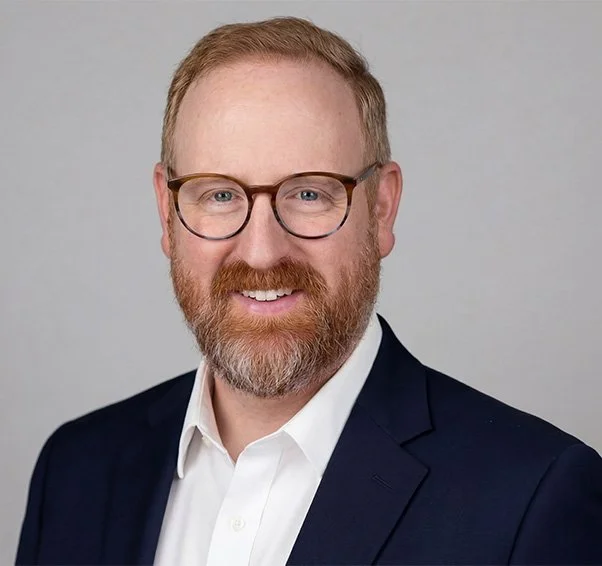
Jarred Smith is the author of Explainable: Why AI Recommends Some Brands & Ignores Others, an Amazon bestseller on AEO, GEO, and SEO. He’s a marketing leader with nearly 20 years of experience across healthcare, public media, retail, and environmental services. Find him at jarredsmith.com.