Three Marketing Workflows Worth Rebuilding Before Year's End

A consulting client walked me through her marketing operation a few weeks ago, and somewhere around minute twenty I realized I was looking at a list of every AI tool that’s been written up in Marketing Week since 2024. The AI-assisted content platform was in there, along with the lead-scoring add-on for the CRM and the new agentic follow-up tool that everybody on LinkedIn keeps posting case studies about. She had the budget for all of it, the team had the training, and her pipeline number was no different than it was eighteen months ago. It’s the same conversation I’ve been having with five other clients this year, which is why I finally decided to write about it.
The three workflows where that gap shows up most clearly are lead gen, content, and follow-up. They’re the whole front half of a marketing operation, which is the part that’s been chewing through budgets and trust for years now. I’ve been doing this work for two decades, across healthcare and public media and retail and a few other industries, and the pattern is consistent. AI does help with all three workflows, and the tools are widely available and getting cheaper. What I see anyway is teams that have bought the stack and still haven’t moved the numbers, and I think I know why.
I want to walk through what I’ve worked out, because I think a few of you are probably running into the same wall.
Lead Gen Has a Speed Problem That No Amount of Headcount Solves

There’s a number from a 2026 Optifai benchmark study of 939 B2B companies that I found really interesting. The average lead response time across that whole dataset is 47 hours. That’s nearly two business days between somebody filling out a form on your site and somebody from your team picking up the phone. The original Harvard Business Review study that started this conversation, back when it was a smaller crisis, put the number at 42 hours. So in twenty years of telling marketers that speed matters, we’ve collectively gotten worse at it.
The piece that more folks should be talking about, at least in my opinion, is the conversion math when you close that gap. Leads contacted within five minutes are 21x more likely to qualify than those contacted after 30 minutes. The close-rate data lines up too. Sub-5-minute responders close at 32%, and 24-plus-hour responders close at 12%. We’re leaving roughly two-thirds of the deal on the table because nobody got back to the prospect before they wandered off to the next tab.
I’ve watched a lot of teams try to solve this with more salespeople, more SDRs, more reminders in the CRM. It doesn’t work, because the bottleneck is the handoff, not the headcount. The form fills at 4:47 on a Wednesday afternoon, a notification goes to a rep who’s on a call, and the rep sees it Thursday morning. By then the prospect has demoed two competitors.
The place AI earns its keep here is inside that handoff. Routing, enriching, scoring, and acknowledging in the ninety seconds after the form fills, so that when a human gets there, they know who they’re talking to and the prospect already knows somebody’s paying attention. A Blazeo benchmark from earlier this year found that 74% of companies miss the five-minute window entirely, and companies with a defined SLA respond within 15 minutes at nearly twice the rate of those without one, 54.9% versus 29.5%. The teams winning on this metric got there by using AI to make a simple thing happen reliably.
If you do nothing else with AI in your lead-gen stack this quarter, automate the first touch. Even an honest “Hi, I’m checking with the right person on our team, they’ll be in touch within the hour” beats a 47-hour silence by a mile (or kilometer for our friends across the pond).
Generic AI Content Is Now a Visibility Liability
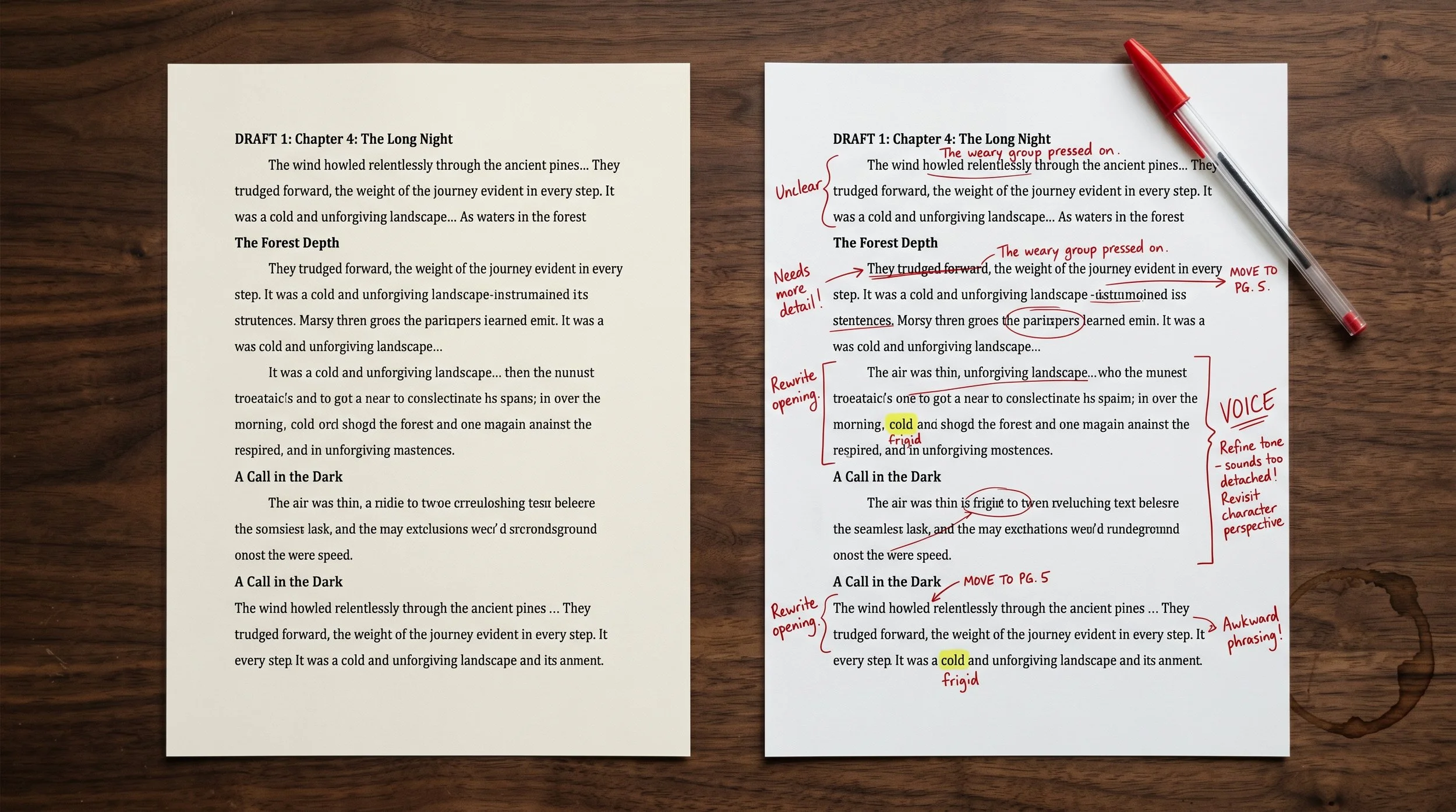
A second thing I keep bumping into is that marketers are still asking AI to “write a blog post about X” and then wondering why the output reads like every other blog post on the internet. There’s a version of this conversation I’ve had probably forty times in the last year. It usually ends with somebody asking me whether they should stop using AI for content, which is the wrong conclusion from the right frustration.
The frustration is fair because generic content used to be merely bad, and now it’s invisible. Answer engines and AI search tools are picking what to cite, and the way they pick rewards specificity, named examples, and a recognizable voice. The way they punish generic, interchangeable phrasing is by skipping it entirely. 91% of B2B marketers use content marketing in some form, and 74% say it’s effective for lead generation, but the gap between the teams seeing real ROI and the teams producing volume for its own sake has widened a lot. If your content can be swapped with any competitor’s by a search-and-replace on the brand name, an AI engine has no reason to surface yours over anyone else’s.
The path through this is to put more of your voice into the AI before you ask it to do anything. I keep a single reusable prompt for every brand I work with that captures three things the business says often, one thing it would never say, the specific phrases customers use back at it, and a couple of anecdotes from real engagements that ground the writing. That prompt gets used as a system message or a preamble on every content task.
The other piece is sourcing. AI-generated content with no specific anchor, no real customer name, no specific number, no actual moment, defaults to slop. Feed the model a transcript from a customer call, or a finished project writeup, or even a Slack thread from when something interesting happened, and you’ll get back something usable. Feed it nothing and you’ll get back nothing.
A lot of the AEO and GEO work I do with clients these days starts here, before any conversation about schema or structured data. The first question is whether the content is recognizably theirs at the sentence level, because that’s the bar an AI engine is now setting before it cites you.
Follow-Up Is Where Most Teams Surrender

The third workflow gets the least attention and does the most damage, which is follow-up. According to Salesforce data cited widely in the industry, 79% of marketing leads never convert into sales because of ineffective lead nurturing. That number floats around so often it’s lost some of its sting, but think about what it means in budget terms. If your company spends $100,000 on lead generation and 70% of those leads are never contacted because of slow or nonexistent follow-up, you have torched $70,000 of that budget.
I’ve sat in enough sales-marketing alignment meetings to know how this goes. The marketing side will say they delivered the leads, and the sales side will say the leads were bad, and both will be kind of right and kind of wrong, and neither will be talking about the part that broke, which is that nobody followed up past the second touch.
AI is useful here in three specific ways, with caveats you have to plan for. It can draft follow-up sequences that adapt to what the prospect did, summarize a long email thread before a callback so the rep walks in with context, and surface the next action before it falls off the radar. Traditional automation runs the same five-touch sequence regardless of what the prospect engaged with. The newer agentic systems can pick a different next message based on whether the prospect watched the video, read the case study, or just clicked the email and bounced. That contextual layer is the part that’s new.
The failure modes matter too. AI-drafted follow-up that sounds like AI-drafted follow-up makes things worse, because a prospect who’s been pinged five times by what’s obviously a bot is harder to recover than one who was just forgotten about. The rule I give clients is plain. AI drafts the message, a human reads it before it goes, and the closing message in any sequence always comes from a real person with their name on it. The middle of the sequence is where automation has the most room to do its job without making things weird.
The System Question
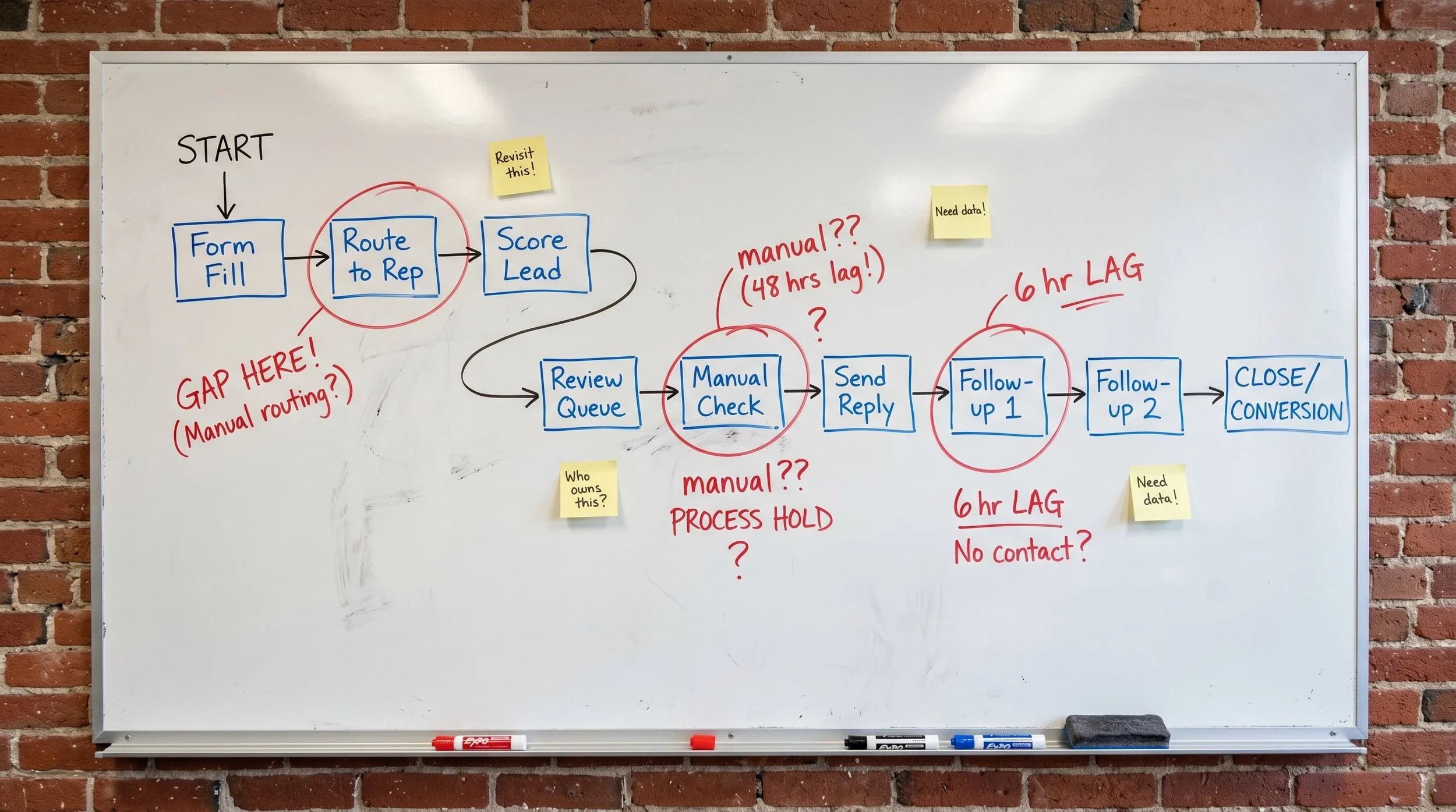
If you’ve stayed with me this long, you’ve probably noticed that lead gen, content, and follow-up all break in the same place, which is the gap between the tools a team owns and the workflow they’re running. Most marketing operations I look at have bought the AI stack and haven’t rebuilt the workflow underneath it. The form routes to an inbox that doesn’t get checked for six hours, the content brief still starts with some version of “write a blog post about,” and the follow-up sequence goes silent after touch number three. The tools didn’t fix any of that, because none of it was ever a tool problem.
A diagnostic, if you want one. Pick the workflow that costs you the most right now and map every step it takes today, on paper, including the human decisions and the handoffs. Then ask which two or three of those steps a halfway competent AI implementation could remove or accelerate. If your answer is “all of them, in theory, with the right tool,” what you have is a tool fantasy; the next purchase won’t help any more than the last one did. Most of the time the answer is more modest, somewhere around “one or two of those steps, and only if we also change how the work moves between them,” which is the answer that tells you the work is in the workflow itself.
The teams pulling ahead this year are the ones who picked one of these three workflows, rebuilt it end to end, and let everything else wait. Tool sprawl on top of broken processes is what got us into a 47-hour response window in the first place.
Jarred Smith is the author of Explainable: Why AI Recommends Some Brands & Ignores Others, an Amazon bestseller on AEO, GEO, and SEO. He’s a marketing leader with nearly 20 years of experience across healthcare, public media, retail, and environmental services. Find him at jarredsmith.com.