
What My Own Analytics Say About AI Search Traffic in 2026 (And What Yours Probably Don't Show You)
On May 22, Barry Schwartz mentioned one of my blog posts in the Search Engine Roundtable newsletter. I watched the visits come in over the next four days from the UTM tag he used: Romania, Switzerland, India, Japan, Lithuania, Germany, the UK, a few US cities, one Canadian session that stayed open for more than twelve hours. Some sessions scrolled to 94% and stayed for an hour, others bounced inside two seconds, and the pattern of who read the post was nothing like the pattern of who clicked on it.
That same week I went through the rest of my referrer log and started counting the AI sources. Claude.ai. Perplexity. Gemini. ChatGPT. NotebookLM. Brand24. Wondershark. iLoveSEO. Tools I had never heard of. The shape of what was hitting my site had shifted from “Google sent a person who searched a keyword” to something more interesting and harder to measure. I want to walk through what I’m seeing, as I don’t think many marketers are looking at their own logs this way. The picture you get when you do is not the picture the dashboards are showing you.
What the referrer log looks like in May 2026
A few patterns jumped out when I sorted the last 30 days.
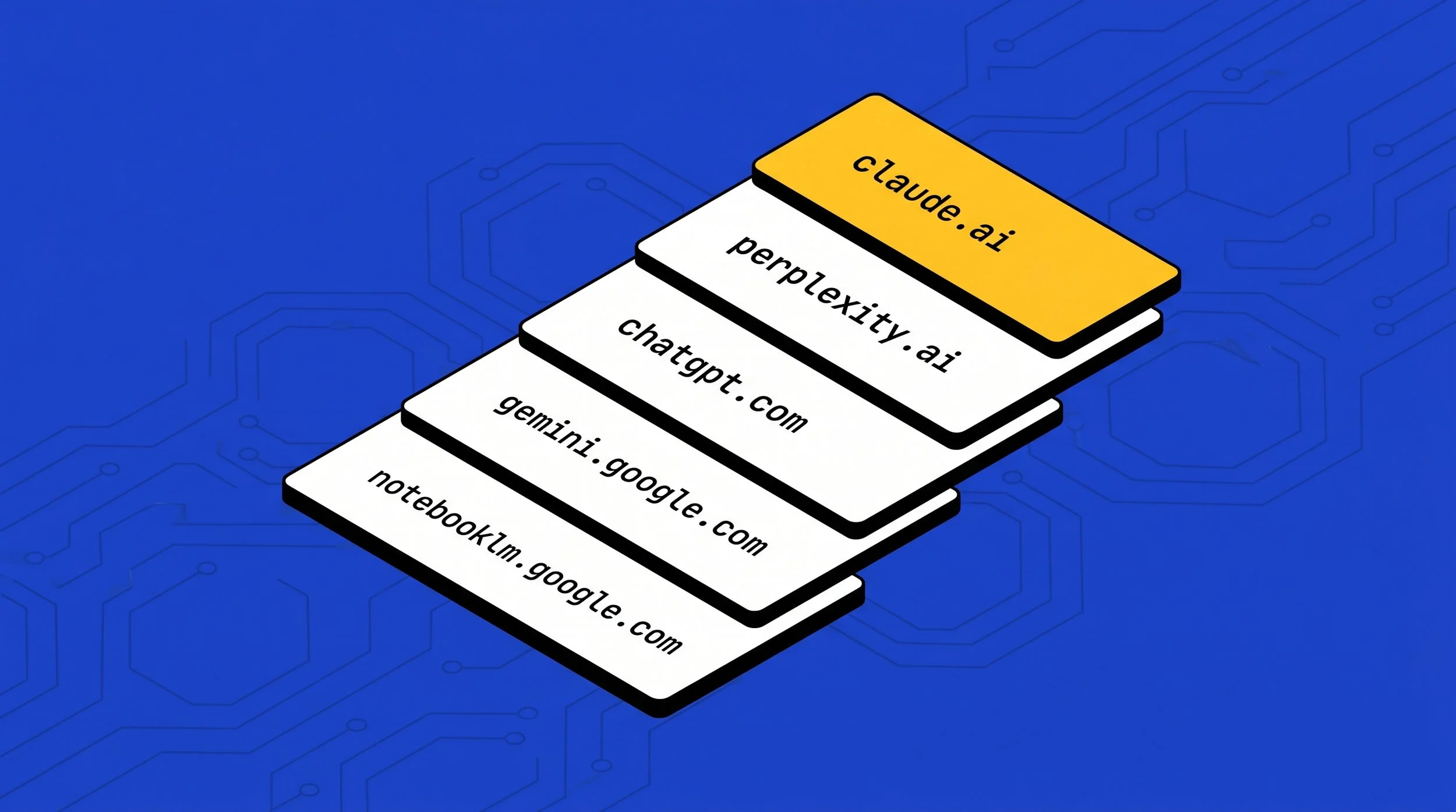
The first is that AI-source referrers are no longer a rounding error. On my site, sessions arriving with claude.ai, perplexity.ai, chatgpt.com, gemini.google.com, or notebooklm.google.com in the referrer field now make up a small but consistent slice of inbound traffic. They’re not the volume Google still drives, but they exist, they convert into longer sessions, and they cluster on specific pages. Cloudflare’s latest network-wide data puts AI bot traffic at 5.58% of all HTTP requests across their network in April 2026. The referrals lag the crawls badly, but the human visits are real.
The second is that the dwell-time signal from AI-referred sessions is unusual. A session from a claude.ai referrer on my “Click That Didn’t Happen” post stayed open for 263,142 seconds with 4% scroll depth. That’s three days. Either the person tabbed it and went on with their life, or they were using it as a reference window while doing other work. Either way, that’s not how a Google session behaves. Google sessions bounce or finish reading; AI-source sessions sit open in a tab and stay there.
The third is that the people clicking through from a respected newsletter behave differently from any other source. The Search Engine Roundtable visits weren’t passive. One session in Tunbridge Wells scrolled to 94% and stayed for around 2 hours. Another in Bern hit nine pages in a single session over an hour. People who arrived from the SER newsletter were exploring the site instead of just reading the headline post. That’s the conversion behavior I see almost nowhere else.
The fourth, and the one that surprises me most, is the volume of bot traffic that does not identify itself as a bot. I see a steady stream of Google-NotebookLM user agents pulling specific posts. I see anonymized Cloudflare and Fastly egress IPs hitting individual article URLs with no referrer and no real browser fingerprint. Some of these are scraper-type tools owned by AI visibility platforms. Some are LLM context retrievals happening in real time as a user asks a question on the other end. I can’t always tell which is which, and that ambiguity matters.
Why GA4 hides most of this by default
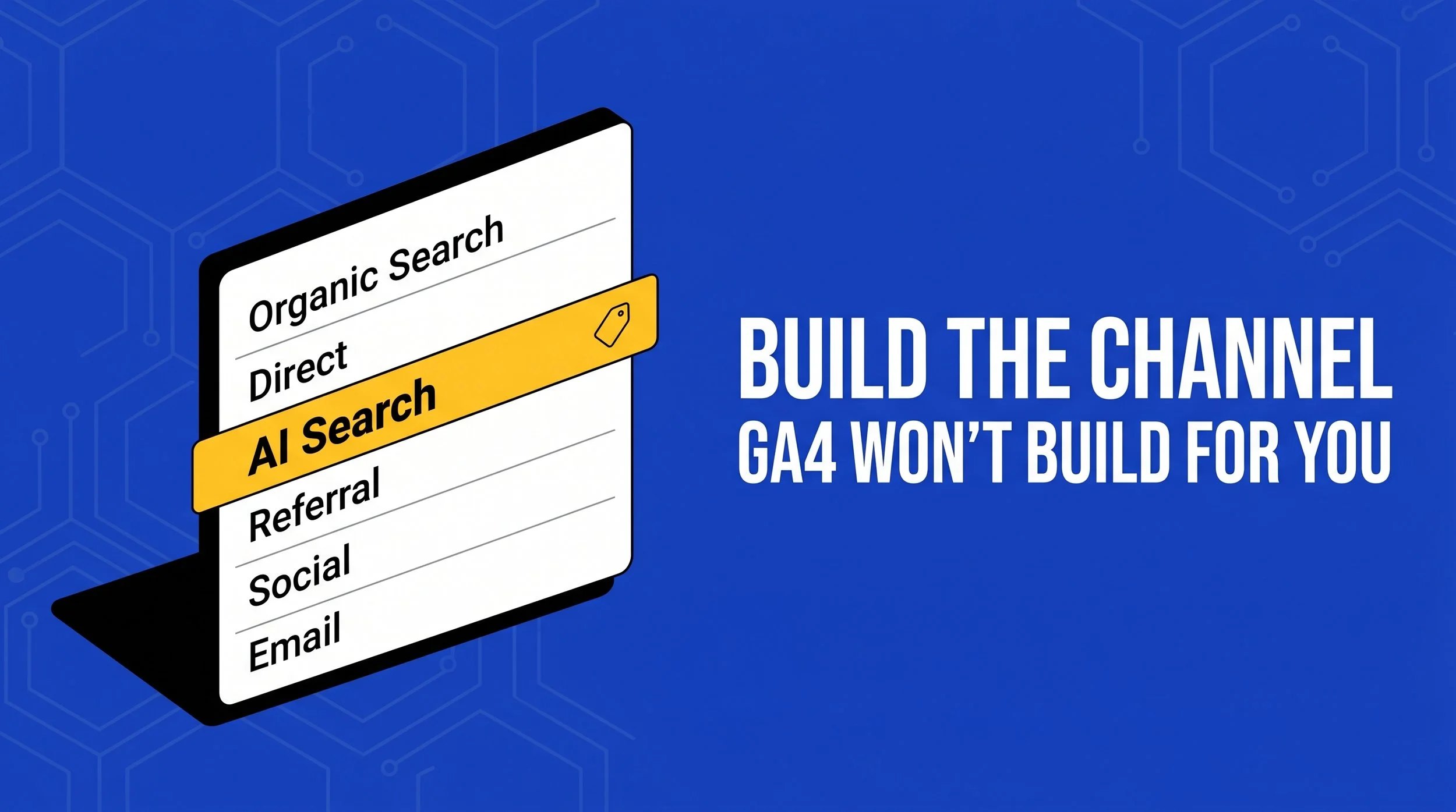
If you open GA4 right now and look at acquisition by source, you’ll see Google, then direct, then maybe LinkedIn or whatever social you push. AI-source sessions get dumped into one of two buckets: “direct” if the referrer was stripped, or “referral” with a long tail of domains that look insignificant on their own and never bubble up to the top of any report. There is no out-of-the-box “AI search” channel in GA4. You have to build it.
I built mine using a custom channel group with regex matching claude.ai|perplexity|chatgpt|gemini|notebooklm|copilot. The moment I did that, what looked like a sub-1% slice of traffic in the standard reports became a tracked channel with its own session quality metrics. Microsoft Clarity’s late-2025 analysis of 1,200+ sites put AI traffic conversion at roughly 3x organic, and Ahrefs found AI visitors converted at 23x the rate of standard organic. Once you can see the channel, you can start asking whether the multiplier is true for your site.
The other thing the dashboards miss is the relationship between crawl and visit. Cloudflare started publishing a metric called crawl-to-refer ratio late last year. It measures how many pages an AI operator’s bots fetch from your site for every one human referral the operator sends back. As of April 2026, Anthropic’s ClaudeBot was crawling 13,528 pages for every visit Claude.ai sent to a publisher. OpenAI’s GPTBot sat at 1,252:1. Perplexity, the friendliest of the lot, ran below 200:1 from late 2025 onward. Google’s traditional Googlebot has held at roughly 5:1 for a decade.
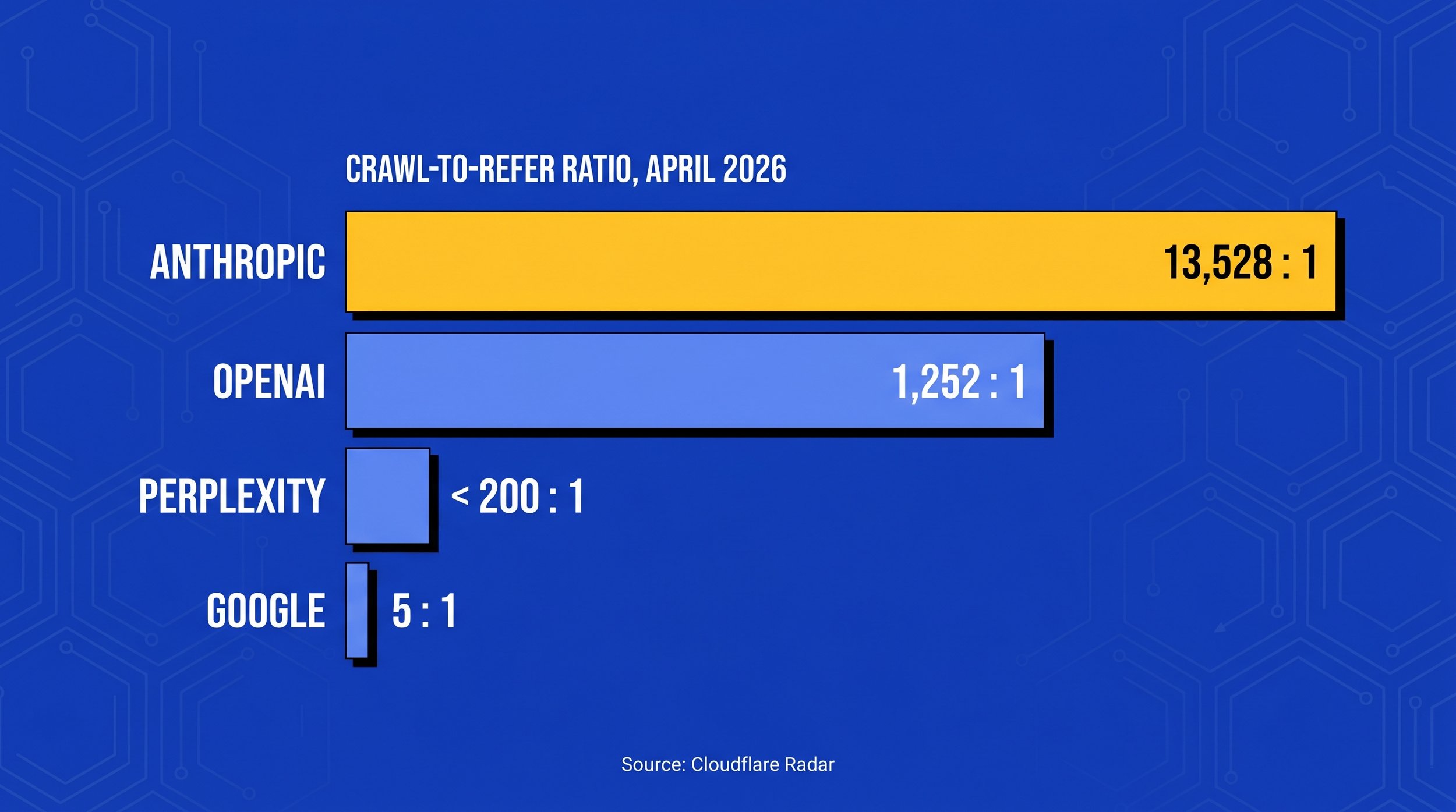
That asymmetry shows up in my own logs. Anthropic’s crawler pulls content from my site every month, and Claude.ai referrals trickle in at a tiny fraction of that volume. The crawler is taking more than the platform gives back, by orders of magnitude. That measurement reality changes how I think about which AI platforms to optimize for first.
What this means if you’re trying to measure AI search visibility
A few things shifted in my thinking once I started looking at my logs this way.
The size of the AI traffic slice is the wrong number to chase. The slice is small everywhere right now. What matters is the quality of it and what it tells you about how AI assistants are referencing your work. A session from Claude.ai is worth knowing about even if it represents one tenth of one percent of your traffic, because it tells you a model surfaced your URL in answer to someone’s question. That is the citation event the Conductor and AirOps benchmarks have been arguing about for a year. Now you can see it happen, on your own site, in your own log.
Dwell time turns into a misleading metric once AI referrers are in the mix. A Claude.ai session that stays open for three days is not “engaged” in any meaningful product sense. It’s a window someone left open. If your engagement metrics are weighted by time on page, AI referrers will inflate them in a way that looks great in a report and means almost nothing about the business. Strip those sessions out of your time-on-site averages, or you’ll be measuring a noise signal.
Newsletter syndication still drives the highest-quality traffic I see, by every measure I trust. Not LinkedIn shares, not paid amplification, not even the long-tail organic that brings most of my volume. A mention in an industry newsletter with a real editorial reputation produces visitors who scroll all the way to the bottom, click through to other pages, and come back. The SER referral pattern I watched this month would be a category of traffic I’d happily trade most of my organic for. Newsletter mentions are exactly the kind of third-party signal that AI assistants weigh heavily when deciding who to cite. The same channel that drives real human visits also tilts the machine visibility numbers in your favor.
Your robots.txt has become a strategy decision rather than a default. I currently allow most AI crawlers because I want to be cited in their outputs. But I’m aware that, per Cloudflare’s network data, 89.4% of AI crawler traffic in Q1 2026 was classed as training or mixed-purpose. Only 2.2% was responding to live user queries. That math gets harder to defend if you’re paying for bandwidth and not seeing a meaningful return in citations or referral traffic. Smaller publishers and individual creators have a different calculus than I do, and I’d take a hard look at whether you want to keep Anthropic, OpenAI, and Meta in your robots.txt allow-list by default.
A few things to do
If you want to see your own version of what I’m describing, a few practical steps will get you most of the way there.
Build a custom channel group in GA4 for AI source. Match referrer hostnames for claude.ai, perplexity.ai, chatgpt.com, gemini.google.com, notebooklm.google.com, copilot.microsoft.com, and anything else you spot in the long tail. Once it’s its own channel, you can compare it to organic, paid, and social on the same screen.
Pull your raw referrer log for the last 60 days and sort by hostname. Look for the AI sources but also look for the SaaS tools that are crawling you for their own AI visibility products: Wondershark, Brand24, Profound, Otterly, Peec. Those aren’t human visits, but they do signal that someone’s customer queried a tool that pulled your content into a report.
Check your crawl-to-refer ratio per platform if you can. If you’re on Cloudflare, AI Crawl Control gives you the data directly. If you’re not, you can approximate by counting unique bot user-agent hits per platform and comparing them to referral sessions from that platform’s chatbot URL. Anthropic and OpenAI will skew badly; that’s expected. The number you want is whether the ratio is improving over time.
Look at your dwell time on AI-referred sessions specifically and decide whether to exclude them from your engagement averages. If they’re sitting open for hours without scroll or click activity, they’re contaminating your reads.
Audit your robots.txt with your bandwidth bill in mind. If you’re paying for crawler traffic that returns nothing, the math should drive the decision, not the default.
What I’m watching next
I’ll keep counting. The pattern that interests me most right now is whether the AI-source traffic share grows as a percentage of total or stays flat while traditional organic continues to decline. Cloudflare’s news publisher data suggests Google referrals to news sites are down somewhere between 27% and 55% year over year depending on the publisher. If AI assistant referrals don’t grow into that gap, the total traffic line gets ugly for everyone whose business depends on it.
If you’ve been running similar analytics on your own site, I’d be curious whether your patterns look like mine or whether you’re seeing something different. The data I’m working with is one site’s logs over a few months, the conclusions are mine, and the patterns are worth checking against your own.

Jarred Smith is the author of Explainable: Why AI Recommends Some Brands & Ignores Others, an Amazon bestseller on AEO, GEO, and SEO. He’s a marketing leader with nearly 20 years of experience across healthcare, public media, retail, and environmental services. Find him at jarredsmith.com.