
What New York's AI Disclosure Law Means for AI Search Visibility
On December 11, 2025, Governor Kathy Hochul signed S.8420-A/A.8887-B into law, making New York the first state to require advertisers to disclose when AI-generated “synthetic performers” appear in their ads. It takes effect June 9, 2026, with penalties from $1,000 for a first violation to $5,000 for each subsequent one, enforced by the New York Attorney General.
Most of the coverage so far seems to be compliance writing like law firm alerts that walk through definitions, exemptions for expressive works and audio-only ads, and the carve-out for AI used purely for language translation. Soona and a few other UGC vendors have, predictably, used the moment to sell human-created content. That’s all fine. I’m writing about something else as I’ve noticed that nobody in the AEO or GEO space is talking about yet. When ad creative starts using machine-readable “AI-generated” labels at scale, what happens to how AI answer engines treat that content? I don’t think anyone knows yet.
What the law requires
The statute amends New York’s General Business Law to require that anyone who produces or creates an advertisement “in any medium or media” must conspicuously disclose if a synthetic performer appears in it. A synthetic performer, per the bill text, is a digital asset created or modified using generative AI (or a software algorithm) that’s intended to give the impression of a human performance, where the figure isn’t recognizable as any identifiable natural person.
The definition is pretty narrow if you really dig into it. It covers AI models, AI UGC creators, AI influencers, and synthetic spokespeople, but a fully AI-generated product shot with no human figure in it probably falls outside the statute. AI-enhanced photography sits in a gray zone that the Davis Wright Tremaine analysis flags as something courts will likely have to sort out.
The form of the disclosure isn’t specified anywhere in the statute, which is the part of this I want to spend talk about. The law just says “conspicuously,” which is the same word the FTC has been using for influencer #ad disclosures for years, and we’ve all watched how those evolved. Eight-point gray text in the corner of a 30-second video clip will probably qualify for the first round of enforcement.
Why this question belongs to AEO
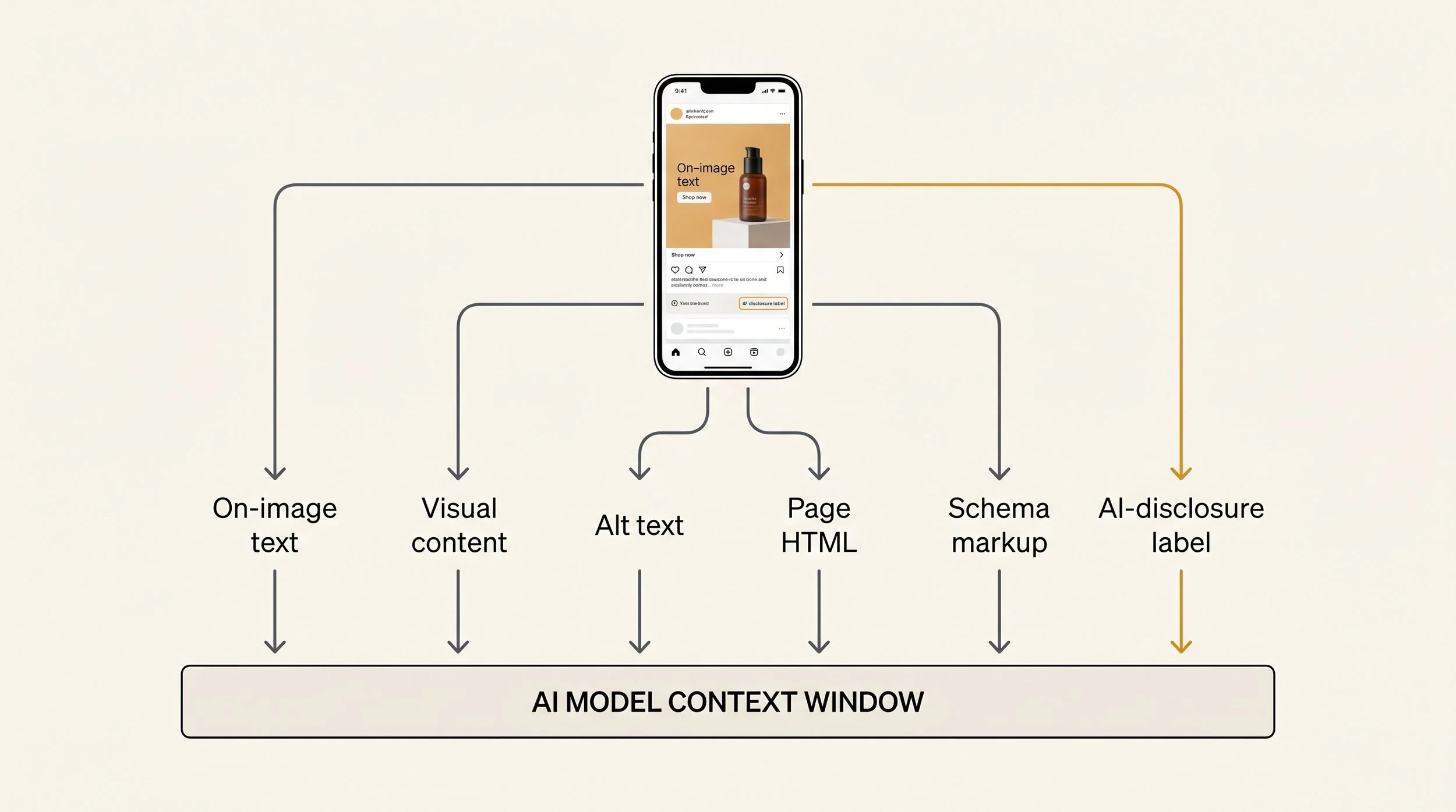
Multimodal AI systems are getting better at parsing what’s in an image or video, including text on the image, metadata attached to it, the visual cues that signal authenticity or synthesis, and the surrounding page content. The whole premise of AEO and GEO is that the same content can be more or less legible to AI answer engines depending on how it’s structured, labeled, and contextualized.
A wave of “AI-generated” labels on ad creative would mean a new, standardized signal entering the visual web at scale. Some disclosures will live in image alt text, some in on-image overlay, some in video captions, some in structured data attached to ad servers. Over time, models that index visual content will see these labels, and they’ll probably start treating labeled content differently from unlabeled content that will undoubtedly matter for brands and creatives.
I do want to make note quickly that there’s no evidence today that ChatGPT or Perplexity or Claude downweight AI-disclosed images in their citation behavior. I haven’t seen that data, and I wouldn’t believe a vendor who claimed they had. What I’m getting at is that we’re about to run a real-world experiment in which a decent amount of commercial visual content carries a machine-readable “this is synthetic” signal, and that experiment is going to produce data. The question is what to do in the meantime.
What we know already
A few pieces of the AEO research community’s work bear directly on this.
AI systems weight content differently based on authority and authenticity signals. Profound’s research on AI citation patterns through 2025 has shown that brands with strong entity signals (author bylines, original research, verifiable claims) get cited at higher rates in AI Overviews and ChatGPT responses than brands without them. That’s not controversial at this point, it’s been consistent across enough independent analyses that I’m comfortable treating it as established.
What counts as an “authenticity signal” has been moving, though. The signals that worked in 2024, mostly schema markup and clean technical SEO, became table stakes by late 2025. The signals that work now are harder to fake, things like original photography, author bios with verifiable third-party mentions, quoted experts with linked credentials, and original data rather than regurgitated statistics. Those things are expensive, which is part of why they work. Models appear to be using cost-of-fabrication as a proxy for trustworthiness, which makes sense if you’ve ever thought about how a system without lived experience would try to distinguish a real claim from a synthetic one.

Multimodal indexing is the other piece. Google’s research on multimodal embeddings and OpenAI’s GPT-4V deployment make it clear that the image is now part of the context window, not just decoration on the page. A brand’s product page loaded with synthetic imagery and a competitor’s page loaded with verified human-shot content are starting to look different to the systems doing the citing, even when the surrounding text is similar.
Put those three pieces together with a state law that creates a standardized AI-disclosure signal on commercial creative, and the picture I’m drawing looks something like this. Brands that have been leaning hard on AI-generated humans for advertising (there are a lot of them) are about to have to label that work. The label itself starts acting as part of the brand’s metadata. Models that index that label, even if they don’t formally penalize it, will be operating in a world where authentic human content carries a small but real differentiation premium.
What I’d watch for between now and December
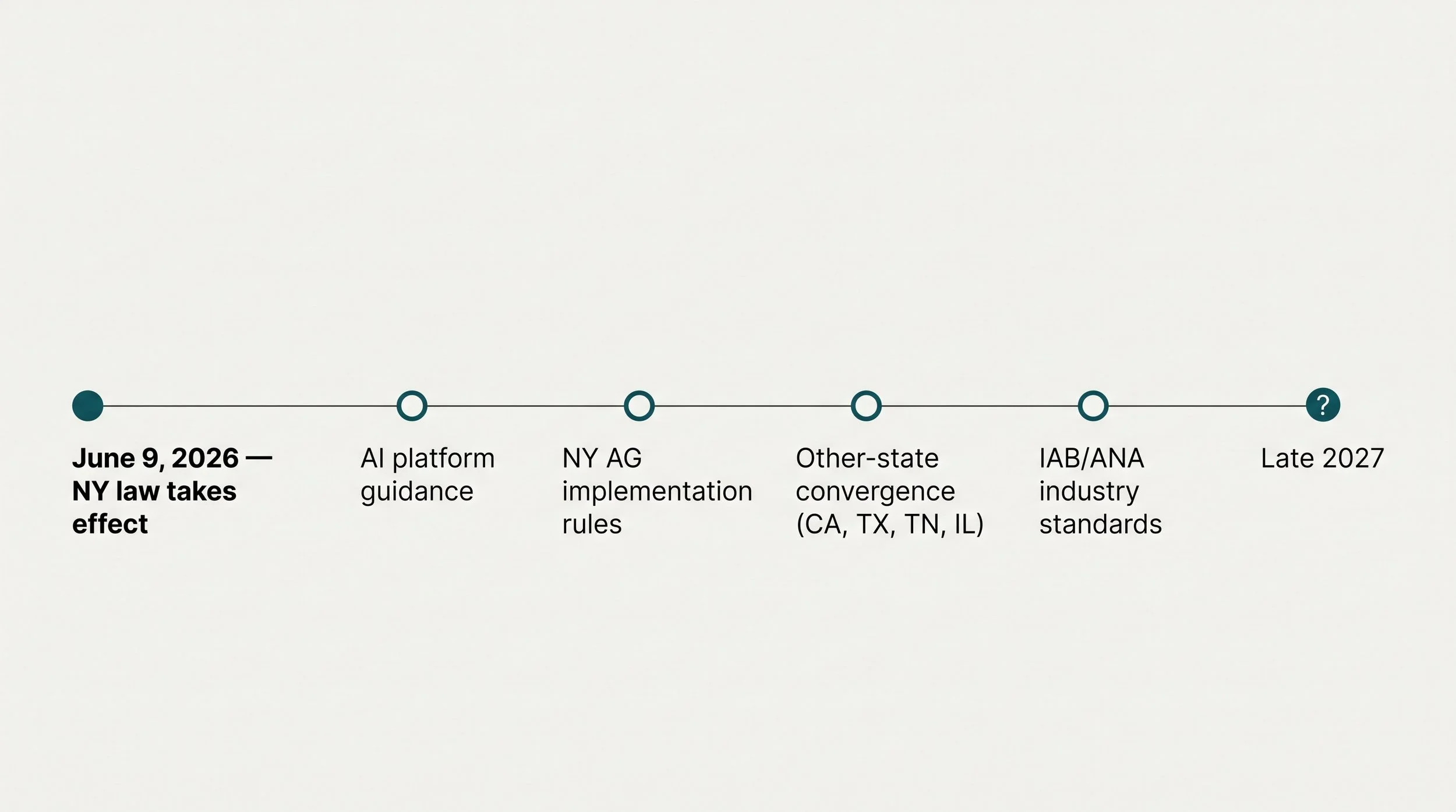
I’m working through this in real time, so treat what follows as things I’m watching, with my best guesses about why each one matters.
The first thing I’m watching is whether the major AI search platforms publish any guidance on how they treat content with AI-disclosure metadata. Perplexity has been the most transparent of the answer engines about its citation logic so far, and if any of them say anything about this in the next six months, it’ll tell us a lot about where the industry is heading.
The second is whether the New York Attorney General’s office issues implementation guidance before June 9. Multiple law firm analyses have noted that the statute’s silence on what “conspicuous” means is going to drive enforcement questions early. If the AG publishes a standard disclosure format, that format will probably become the de facto signal that multimodal models start indexing on, which makes it more important than the marketing press has treated it.
The third thing I’m watching is whether other states follow. California has SB 942 on the books already covering a different slice of AI content, and Texas, Tennessee, and Illinois all have AI-related disclosure bills moving. If three or four large states converge on a similar disclosure standard, we’re no longer talking about a New York compliance issue, we’re talking about a national signal in the visual web that brands have to operate inside.
The fourth is whether the IAB or ANA publishes guidance for member brands. I’ve been talking to a few people at the ANA about how the industry plans to respond, and the early read is that nobody quite knows yet, which is consistent with where things were on influencer disclosure a decade ago. The industry tends to converge on a standard about 18 months after the first state acts. That puts us at a usable disclosure standard sometime in late 2027, which is exactly the window where the AEO implications I’m describing will either start showing up in citation data or they won’t.
A few things to do in the meantime
If I were running a brand’s marketing function right now, I’d be doing three things.
First, audit the visual creative library and figure out how much of it is AI-generated humans versus authentic human content. A brand running an AI UGC program through a vendor like Arcads or Synthesia has a New York compliance project on its hands by June, and the audit needs to happen in the next 30 days, not the next 90.
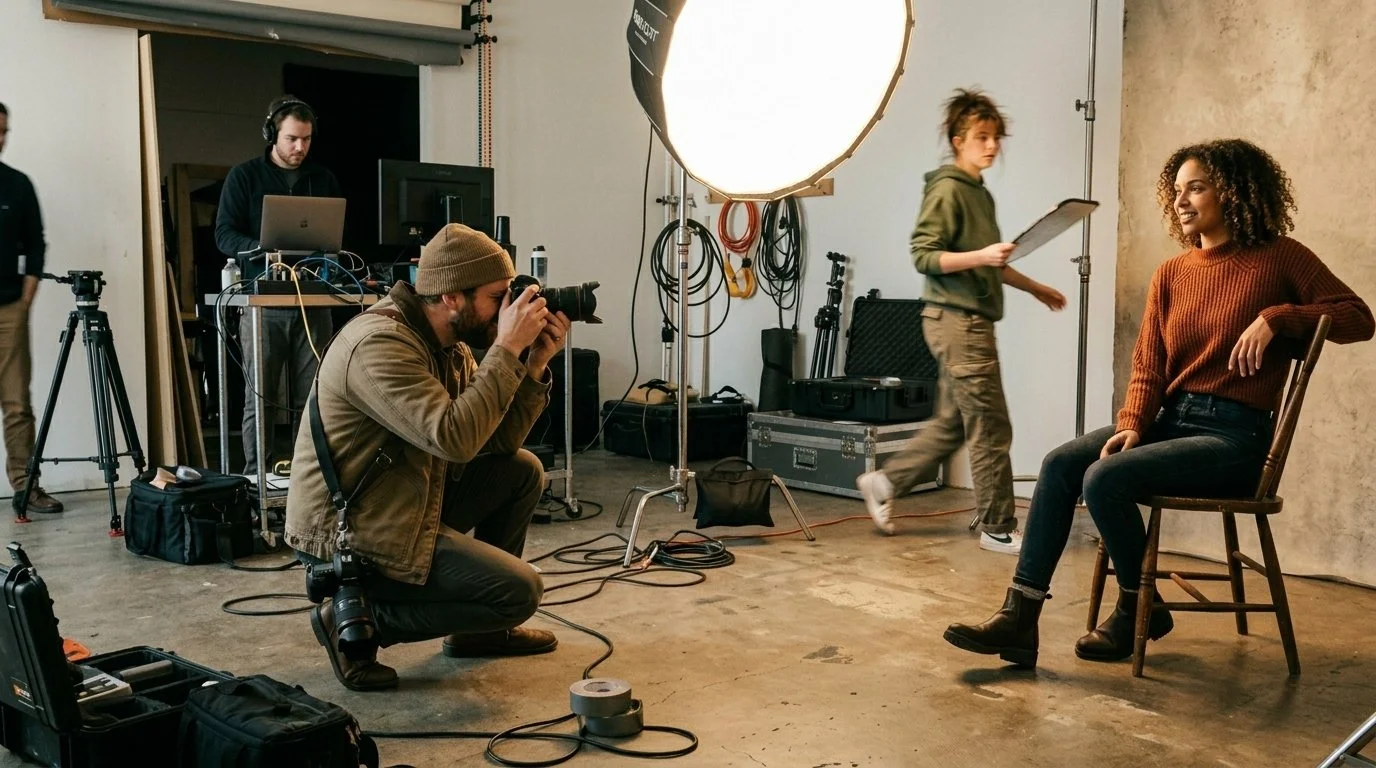
The second thing is to start building or commissioning a library of verified human content that can carry the brand through the transition. That means real shoots with real models and signed releases and originals the brand owns. If multimodal AI weighting moves in the direction I’m describing, a deep library of authenticated human content becomes a compounding visibility advantage that’s hard for late movers to catch up on.
The third is the disclosure format itself. The law doesn’t specify what conspicuous looks like, so a brand that gets out in front of this with a clear, well-designed disclosure has a chance to set the template that everyone else copies. Hiding the disclosure in 8-point gray text is a slower-burning version of the same mistake brands made with the FTC’s #ad guidance. I’d rather be in the first group.
Where I’m uncertain
Here’s what I’m not confident about. A lot of marketing writing about AI right now makes it sound like everyone has it figured out, and I don’t think anyone does.
I’m not sure whether the multimodal weighting effect I’m describing is large or small in the short term. The volume of disclosed content might be small enough for the first 12 months that AI systems don’t materially differentiate based on it. The effect could also compound faster than I think, especially if Adobe or Google embed disclosure metadata directly into Creative Cloud or YouTube uploads, in which case the signal becomes pervasive almost overnight.
I’m also not sure whether enforcement will be vigorous. New York’s AG has a lot of priorities, and a $1,000 first-offense penalty isn’t scary enough for a brand with a national ad budget. Light enforcement could mean the law ends up as a paper tiger and the downstream signal effect I’m sketching never materializes.
The thing I’m confident about is that the question is worth taking seriously now, while there’s time to position for it. Brands that wait for the data to come in are going to be 18 months behind the ones already building authenticated content libraries and thinking about how their creative reads to a multimodal model.
The AEO and GEO work most of us have been doing has been text-first up to this point. This is the moment that work starts to extend into visual content in public, with a regulatory event creating the test conditions. The book I wrote, Explainable, covered the text side of it in detail. The visual side is where I think the interesting questions are going to live for the next couple of years, and I’ll keep writing about what I find.
Jarred Smith is the author of Explainable: Why AI Recommends Some Brands & Ignores Others, an Amazon bestseller on AEO, GEO, and SEO. He’s a marketing leader with nearly 20 years of experience across healthcare, public media, retail, and environmental services. Find him at jarredsmith.com.