Google Just Called Most GEO Tactics Useless. It’s Right, for Exactly One Search Engine.
My feed spent the first week of June doing a victory lap.
Google had finally said the thing a certain crowd of SEOs spent two years waiting to hear, that all the answer-engine, optimize-for-the-robots stuff was a bubble and the people selling it were selling air. On June 5, Google folded AEO and GEO into its long-running “Do you need an SEO?” hiring guide and published a fresh page on how to vet third-party tools. A few weeks earlier, on May 15, it had put out a standalone guide to optimizing for generative AI features. The line everybody screenshotted came from that guide. Google’s stance is that because its AI features run on the same search experience, optimizing for them is the same work as regular SEO.
Cue the dunking.
Some of it landed. A fair number of GEO pitches from the last year deserved a dunk. Google’s own changelog describes the new guide as busting common AEO and GEO misconceptions, and the myths it busts are the ones a lot of consultants were charging for. You don’t need an llms.txt file. There’s no requirement to chop your pages into bite-size chunks for the model, no special schema waiting to be discovered in the docs, and no secret robot dialect you’re supposed to write in. Google said all of that out loud, in writing, on a page anyone can read. If your whole offer was a stack of those tricks, this was not your week.
So far I’m with the crowd. Where I get off is the next sentence everyone tacked on, the one that goes “see, it was all just SEO the whole time, nothing changed.” That part doesn’t hold.
What Google is describing is Google
Read the guide closely and you’ll notice it’s careful about its own scope. It’s about Google’s surfaces, AI Overviews and AI Mode, and the way those features pull content. Local Falcon’s breakdown of the guide lays out the two mechanics Google leans on. The first is retrieval-augmented generation, where the AI answer is grounded in pages from the same index that powers regular search, with links back to the source. The second is query fan-out, where one question spawns a handful of related searches before the answer gets assembled. Both run on Google’s index. If you’re not in it, you’re nowhere.
For Google’s own engine, “it’s still SEO” mostly holds up, and the data backs that. Discovered Labs found that 54% of AI Overview citations overlap with the top-20 organic results, and 97% of Overviews cite at least one page from the top 20. So if you rank well on Google, you’ve got a real shot at being pulled into Google’s AI answers. Fine. I’ll take that deal.
The problem is that Google is one engine, and it’s becoming the least representative one.
The engines don’t agree with each other, and it’s not close
The “just SEO” story falls apart on the numbers, not on vibes. An analysis of 680 million citations found that only 11% of domains get cited by both ChatGPT and Perplexity for the same kind of query. Pull back to the whole field and roughly 71% of cited sources show up on only one platform. The engines are drawing from different pools of sources. And they each have a personality. That same ZipTie meta-analysis pulled the source preferences apart by platform. ChatGPT leans hard on Wikipedia. Perplexity has a Reddit habit you could set your watch by. Google’s Overviews reach for YouTube more than the others do. Claude favors long, structured blog content. None of that is random. They were built by different teams, on different indexes, with different ideas about what makes a source worth trusting, so of course they cite different things.
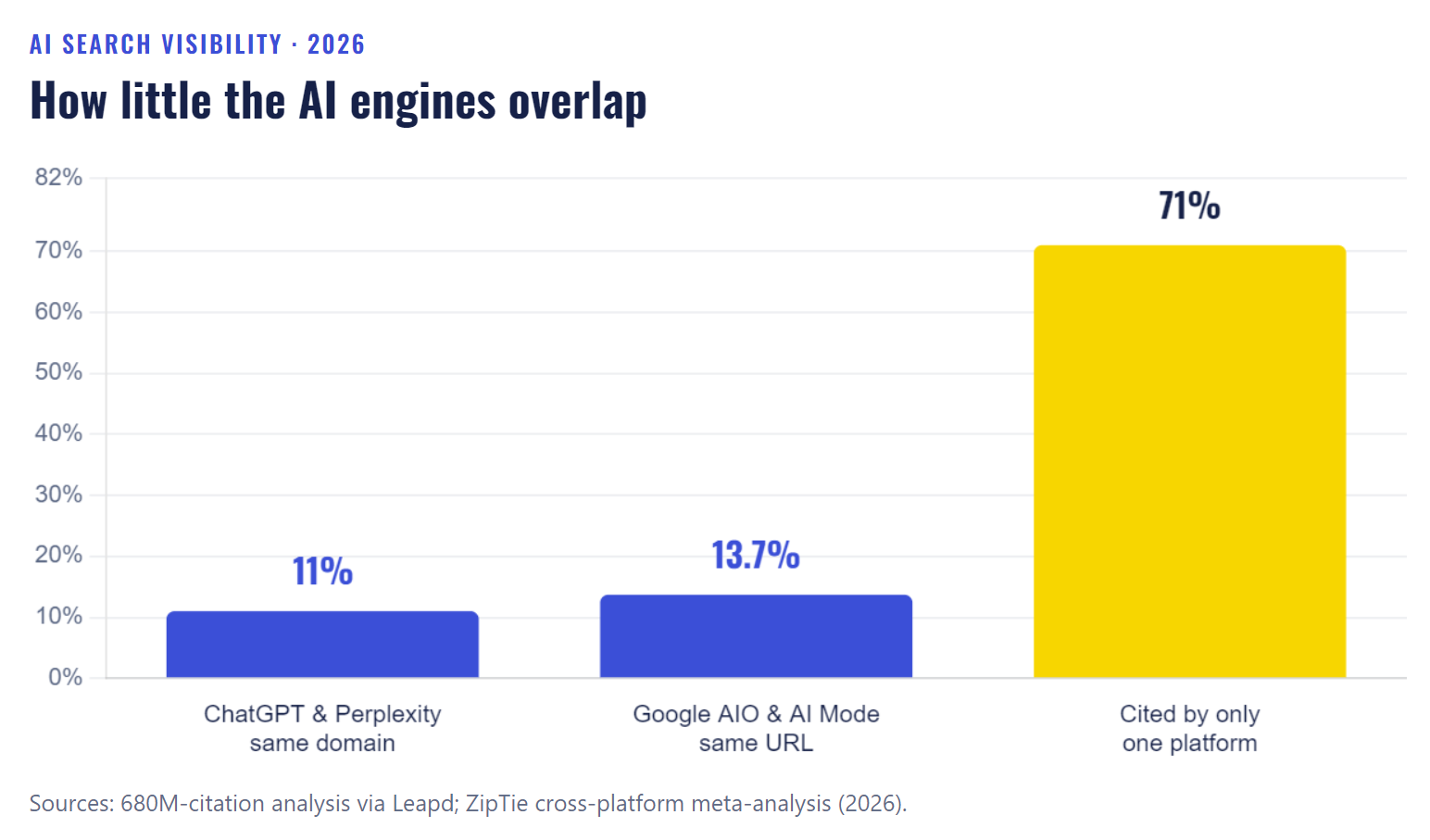
My favorite number in the pile is also the most damning. Google’s own two products, AI Overviews and AI Mode, cite the same URL only about 13.7% of the time. Google can’t even agree with itself. If the company that wrote the “it’s still SEO” guide can’t get its two AI surfaces to pull the same sources, the idea that one playbook covers all of them was always going to be a stretch.
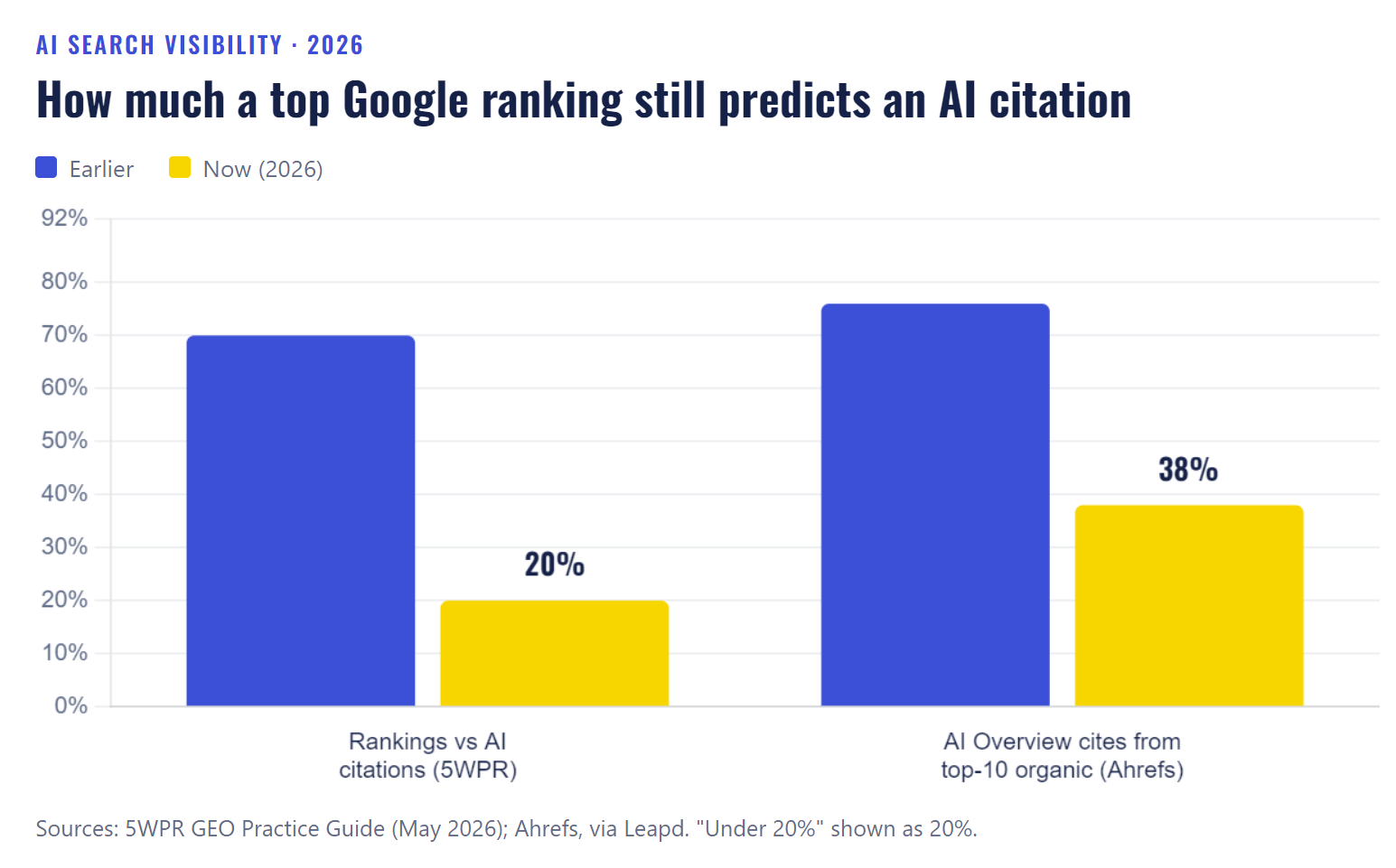
Then there’s the part that should worry you if your whole visibility strategy is “rank number one and wait.” 5WPR’s research found that the overlap between top Google rankings and the sources AI engines cite has fallen from about 70% to under 20%, and it’s still dropping. Ahrefs tells a similar story from another angle, with the share of AI Overview citations coming from the top 10 organic results sliding from 76% in mid-2025 to 38% by early 2026. Ranking still helps, it just isn’t the whole game anymore.
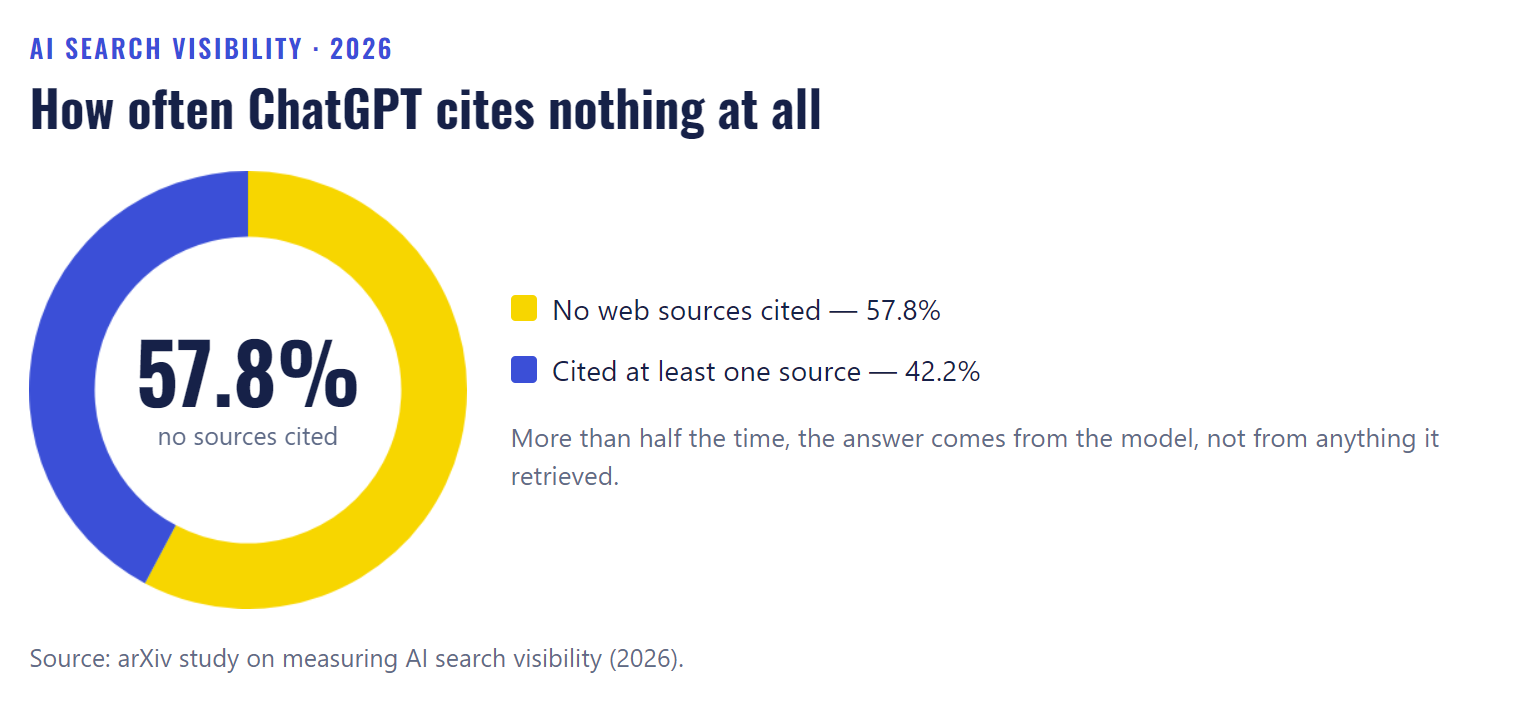
One more, because it changes how you should approach ChatGPT. A research paper measuring AI search citations found that ChatGPT only fires up web search for some queries, and 57.8% of its runs came back with zero citations. More than half the time it’s answering from what’s baked into the model, not from anything it retrieved that minute. You can do perfect on-page SEO and still not exist in that answer, because there was no retrieval step to catch you.
What to do with all this
I’m sure of some of this and guessing at the rest, so I’ll flag which is which as I go. Take Google at its word, for Google. Stop paying for llms.txt files and chunking schemes and secret schema. Google said it doesn’t use them, and Google is the one engine where its own statement is the final word. That money does more if you spend it making pages worth citing, which is the advice that keeps winning.
Stop treating “AI search” like one destination. It’s at least four, and they reward different things. ChatGPT cares more about your Wikipedia presence and how the wider web describes you than about your meta tags. Perplexity weighs the conversation happening about you on Reddit and other community sites. Google’s surfaces still lean on classic ranking to do a lot of the work. It’s one brand doing four different jobs, and a single “AI visibility” score papers over the whole thing.
Measure per engine, and be honest about what you can and can’t see. Google launched AI performance reports in Search Console on June 3, starting with a slice of UK site owners, and it’s the first first-party look at how your content shows up in AI features. It’s also Google-only, and it doesn’t include click data yet. Nobody, including the tool vendors, has first-party citation data out of OpenAI. Google said as much itself when it noted that third-party tools can’t see its internal ranking signals, and that cuts both ways. The true version of any “AI visibility score” is an estimate built on sampling, not a readout from inside the machine. Useful, sometimes very useful, but an estimate. Treat anyone selling you a guaranteed lift in citations as someone who hasn’t read the page Google just published.
Why some brands get recommended and others get skipped
None of the June news closed the question everyone’s been circling. If anything it made the question more relevant. Why does ChatGPT hand a prospect three of your competitors when you rank first on Google for the exact term they typed? Why does Perplexity love a brand that Google’s Overviews ignore? Those gaps are the story now, and they’re widening.
That’s the question I wrote Explainable around, why these systems recommend some brands and skip right over others. Google publishing a guide that explains its own engine, and only its own engine, didn’t make that question go away. It mostly confirmed it was the right one to be asking.
The “it’s all just SEO” crowd got the easy half right and the hard half backwards. SEO is table stakes for one engine out of four, on a results page fewer of your buyers visit every quarter. The brands that win the next two years are the ones who stop optimizing for a search engine and start becoming the answer, on each surface, in their category.
That work doesn’t fit in an llms.txt file, which is the one thing Google and I completely agree on.

Jarred Smith is the author of Explainable: Why AI Recommends Some Brands & Ignores Others, an Amazon bestseller on AEO, GEO, and SEO. He’s a marketing leader with nearly 20 years of experience across healthcare, public media, retail, and environmental services. Find him at jarredsmith.com.