
Google AI Mode Just Got Personal, and Nobody Can Track What It Recommends Anymore
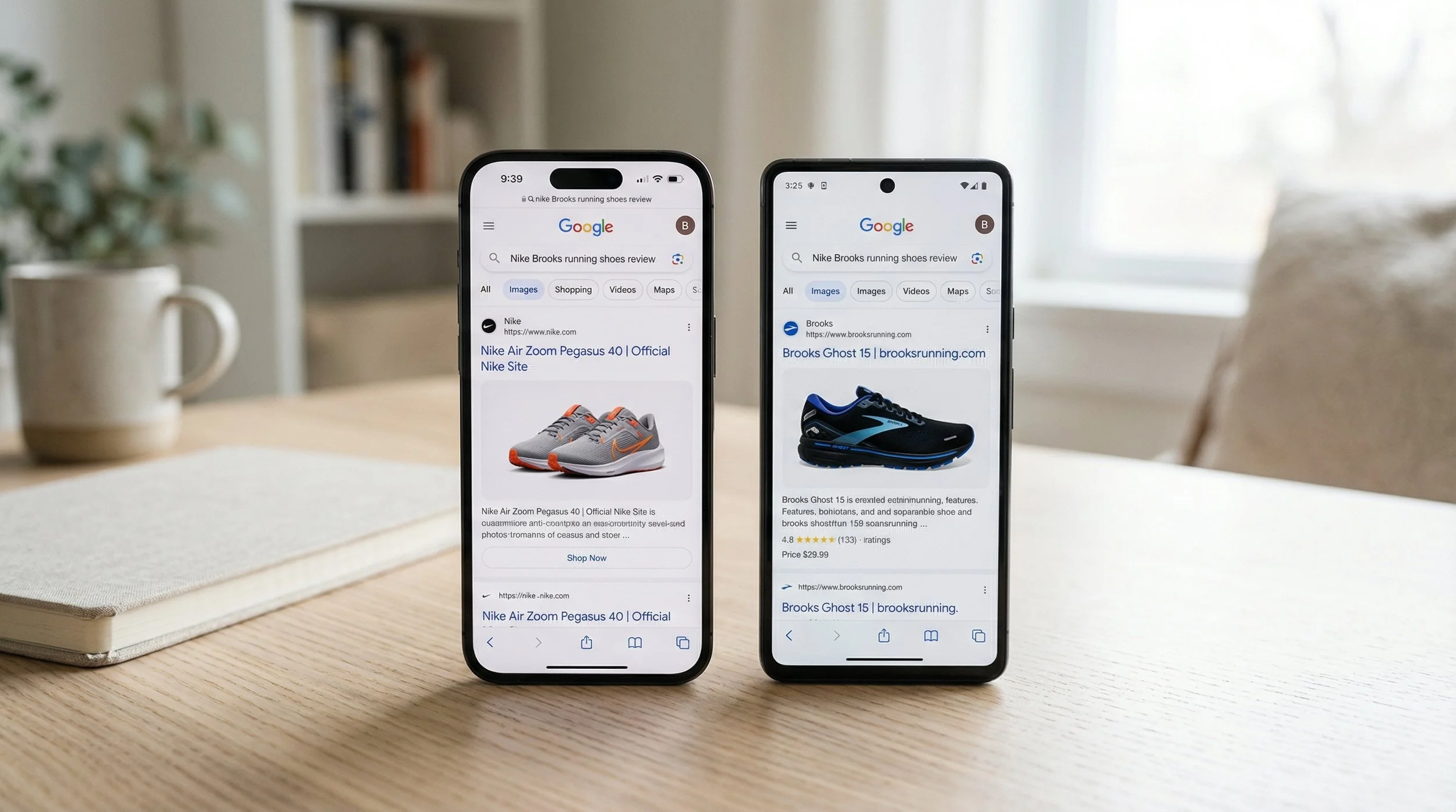
On March 17, Google flipped a switch that most marketers haven't fully processed yet. Personal Intelligence, a feature that was previously locked behind paid AI Pro and AI Ultra subscriptions, rolled out to every free-tier user in the U.S. across AI Mode, Gemini, and Chrome. It connects Gmail, Google Photos, and purchase history directly to Google's AI-powered search results.
That means two people can now search the exact same query and get completely different brand recommendations based on their email receipts, travel bookings, and photo libraries. A search for "best running shoes" might surface Nike for someone who bought a pair last year (per their Gmail confirmation), while the same query returns Brooks for someone whose Google Photos are full of marathon finish lines.
This isn't a minor feature update; it's a fundamental shift in how AI search delivers brand recommendations, and it has massive implications for anyone trying to understand why AI recommends some brands and ignores others.
The Numbers Behind the Shift
Let's ground this in data before we get into what it means for your brand strategy.
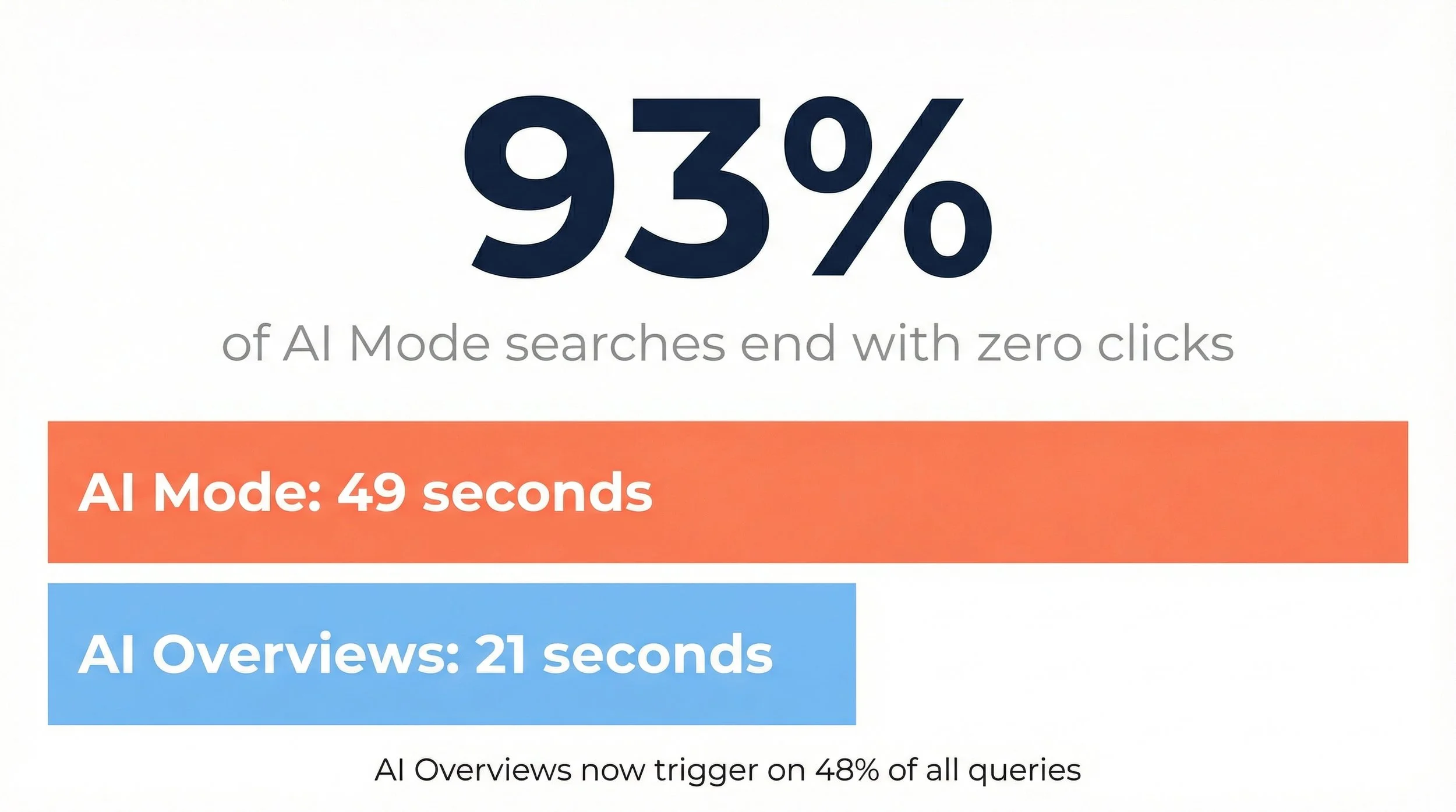
Ninety-three percent of Google AI Mode searches now end without a single click to an external website. Compare that to standard Google search, where roughly 34% of queries result in zero clicks. AI Mode users spend an average of 49 seconds per session compared to 21 seconds in AI Overviews, which tells you people aren't just skimming these results; they're reading them, trusting them, and moving on with their day. AI Overviews now trigger on about 48% of all tracked queries, a 58% increase over last year.
Meanwhile, the behavioral shift is accelerating on the consumer side. Thirty-seven percent of consumers now start their searches with AI tools, and 47% say AI shapes which brands they trust. Monthly AI search sessions are now 56% the size of traditional search globally; yet traditional search volume hasn't declined at all. Total search volume across engines and LLMs increased 26% worldwide. AI isn't cannibalizing search so much as expanding it in a way where the user never visits your website, which changes everything about how brand impressions are formed.
Why Personalized AI Search Breaks Traditional AEO Tracking
Here's where things get uncomfortable for the emerging AEO (Answer Engine Optimization) and GEO (Generative Engine Optimization) industry.
The entire premise of AEO/GEO tracking tools is that you can query an AI engine with a set of prompts, record which brands get mentioned, and benchmark your visibility against competitors. Profound, the first company in this space to reach a billion-dollar valuation (they closed a $96 million Series C in late February at a $1B valuation), built their business on exactly this model. Adobe launched its LLM Optimizer with a Chrome extension that scores your pages for "machine-readability." BrightEdge shipped AI Hyper Cube on March 10, a dashboard for tracking brand visibility across AI search platforms. Semrush, Ahrefs, and a dozen new entrants are all racing to capture budget for this emerging line item.
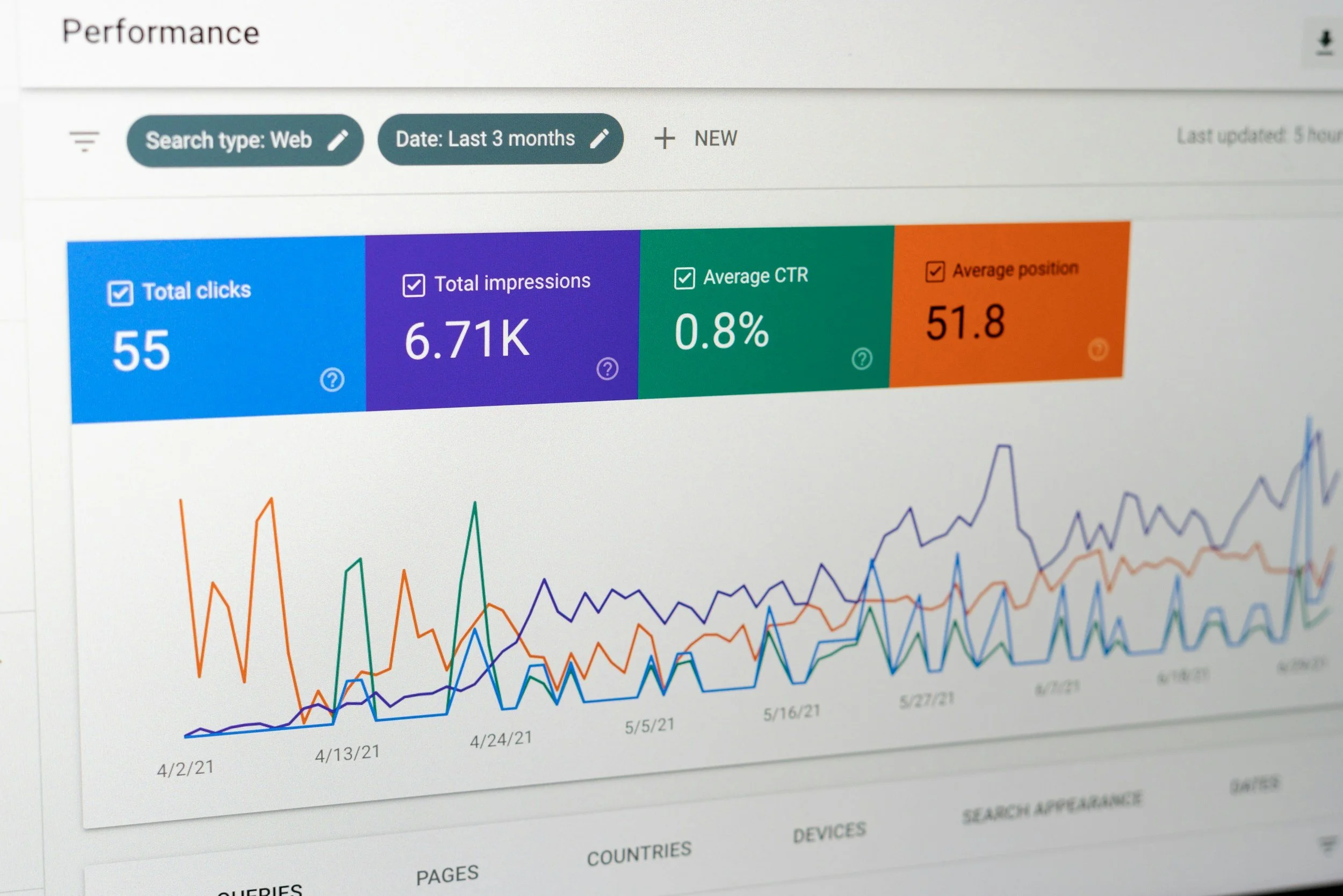
But here's the problem: if Google AI Mode now personalizes results based on each user's email history, purchase behavior, and photo library, what exactly are these tools benchmarking? The answer they get when they query Google AI Mode is their answer, shaped by their data signals, not your customer's answer. And your customer's answer is shaped by a set of personal inputs that no third-party tool can access or replicate.
Rand Fishkin, the SparkToro co-founder and longtime search industry voice, has been banging this drum since January. He's called AI tracking methodologies "snake oil at insane markups," pointing out there's less than a 1-in-100 chance that ChatGPT or Google's AI will return the same list of brands when the same question is asked 100 times. BrightEdge's own research backs this up in a roundabout way; they found only 13.7% citation overlap between AI Overviews and AI Mode for identical queries. Two Google products, queried with the same words, citing almost entirely different sources.
Add personalization on top of that variability, and you've got a visibility landscape that resists measurement in any traditional sense.
What Actually Drives Brand Citations in AI (Despite the Noise)
So does that mean optimizing for AI visibility is a waste of time? Not at all, but it does mean the approach needs to be fundamentally different from what most of the AEO/GEO vendor ecosystem is selling.
The research on what actually correlates with AI brand citations is surprisingly consistent across studies, even as the outputs themselves remain variable. Brands are 6.5x more likely to be cited through third-party sources than through their own domains. YouTube mentions and branded web mentions across independent sites are the top factors correlating with AI brand visibility across ChatGPT, AI Mode, and AI Overviews. Nearly 44% of all LLM citations come from the first 30% of a page's text, meaning content structured with clear, direct answer blocks in the opening 100 words gets extracted at significantly higher rates.
Here's a stat that should make traditional SEOs feel better about their career choices: 76% of URLs cited in AI Overviews also rank in the top 10 of Google organic results. Your traditional SEO foundation isn't obsolete; it's actually feeding AI visibility.

The SEOFOMO 2026 survey of industry experts found that the "overwhelming majority" believe foundational SEO strategies remain the primary drivers for AI visibility. Lily Ray's viral February Substack post, "Your GEO Strategy Might Be Destroying Your SEO," documented a pattern she calls "Mount AI" where sites that chased AI content shortcuts saw brief surges followed by devastating crashes when Google's quality filters caught up.
The conversion data makes this even more interesting. AI-referred visitors convert at 4.4x the rate of organic search visitors. ChatGPT referral traffic specifically converts at 15.9% compared to Google organic at 1.76%. The volume is small, but the quality is remarkable, which means the brands that do get cited in AI are seeing outsized business impact from those mentions.
ChatGPT Now Sells Ads, and That Changes the Incentive Structure
The other major development that's reshaping this landscape happened on February 9, when OpenAI officially began displaying ads in ChatGPT for Free and Go tier users in the U.S. The ads appear below AI responses as labeled units at roughly $60 CPM, which is about 3x what Google Search charges. Initial brand commitments reportedly run $200K to $250K, with retail brands claiming 44% of early ad inventory.
This creates a two-track system that didn't exist three months ago. There are now organic brand mentions within ChatGPT's answers (which OpenAI maintains are never influenced by advertising), and there are paid placements directly below those answers. Seer Interactive's analysis of over 206,000 ChatGPT responses found that the citation algorithm changed 46 days before the ad announcement, with citations per response jumping 81% in December 2025. Whether that's coincidence or infrastructure preparation for an ad-supported model is a question worth asking.
Perplexity moved in the opposite direction, killing its sponsored-answers program in February to double down on subscriptions, which are now approaching $200 million in annual recurring revenue. The Amazon vs. Perplexity lawsuit, where a federal judge initially blocked Perplexity's Comet shopping agent from completing transactions on Amazon, is shaping up to be a landmark case for agentic commerce law.
The takeaway for brand strategists is that the AI answer layer is no longer a neutral space; it's becoming a commercial ecosystem with paid and organic tracks, just like traditional search did 20 years ago. The brands that understand how to build genuine authority (the kind that earns organic mentions) while also understanding the paid landscape will have a compounding advantage over those who treat AI search as an afterthought.
What Smart Brands Should Actually Do Right Now
I wrote Explainable because I saw a gap between the hype around AI search and the practical frameworks marketers actually need. That gap has only gotten wider in the weeks since the book launched. Here's what I'd tell any marketing leader processing all of this right now.

Don't abandon your SEO foundation. With 76% of AI Overview citations pulling from top-10 organic results, your traditional SEO work is doing double duty whether you realize it or not. The sites that crashed in Lily Ray's "Mount AI" analysis were the ones that tried to shortcut their way to AI visibility without the underlying quality signals. Strong technical SEO, authoritative backlink profiles, and well-structured content are still the bedrock.
Build your brand's third-party ecosystem deliberately. If brands are 6.5x more likely to be cited through third-party sources than their own domains, then your PR strategy, your review generation, your guest content placements, and your YouTube presence aren't just "nice to have" brand activities. They're the primary input layer for AI recommendations. Think of every credible mention of your brand on an independent site as a vote that AI models are counting.
Structure your content for AI extraction. That 44% citation rate from the first 30% of text isn't a coincidence; AI models are pulling from introductions and summary sections, which means your most important brand claims can't be buried in paragraph eight. Lead with clear, direct answers in 40-60 word blocks, and make your opening content the version you'd want an AI to quote.
Be cautious with AEO/GEO tracking spend. I'm not saying these tools have zero value, but be realistic about what they can and can't measure. With Google AI Mode now personalizing results based on user-specific data, with AI Overviews swapping 45.5% of citations each time they regenerate, and with less than 14% overlap between Google's own AI products for the same query, the snapshot you're getting from any tracking tool is just that: a snapshot of one possible answer from one moment in time. Use it directionally, but don't build your entire strategy on it.
Watch the regulatory calendar. The EU AI Act's August 2, 2026 deadline will require AI-generated content to carry machine-readable and human-visible labels. Colorado's AI Act takes effect in June and California's AI Transparency Act hits in August, so this isn't just a European concern. Google's antitrust saga, with the DOJ and 38 states pushing for structural remedies potentially including Chrome divestiture, could fundamentally reshape the AI search landscape. Penske Media's lawsuit specifically targeting AI Overviews argues that Google has broken the basic content-for-traffic bargain that powered the open web for decades. None of these are abstract policy debates; they're forces that could change the rules of the game while you're still learning to play it.
The Brands That Win Will Be the Ones Worth Talking About
Here's the thing that gets lost in all the tool debates and tracking discussions and platform updates: AI models, at their core, are pattern-recognition systems trained on the sum total of public conversation about your brand. Personal Intelligence adds another layer to that by incorporating individual user behavior, but the underlying principle hasn't changed.
The brands that AI recommends consistently, across platforms, across personalization signals, across the variability in outputs, are the brands that show up in enough credible, independent, well-structured sources that the models can't ignore them. They're the brands that have built something worth mentioning.
You can't hack your way into that kind of authority, and you can't buy it with a $250K ChatGPT ad buy or shortcut it with AI-generated content farms. You have to earn it the old-fashioned way: by being consistently useful, consistently visible in credible places, and structured well enough that when an AI goes looking for the best answer to give a user, your brand is the one it keeps finding.
That's what I mean by "explainable." When you understand the inputs, the outputs start making sense, even when every user's results look a little different.

Jarred Smith is the author of Explainable: Why AI Recommends Some Brands & Ignores Others, an Amazon bestseller on AEO, GEO, and SEO. He's a marketing leader with nearly 20 years of experience across healthcare, public media, retail, and environmental services. Find him at jarredsmith.com.